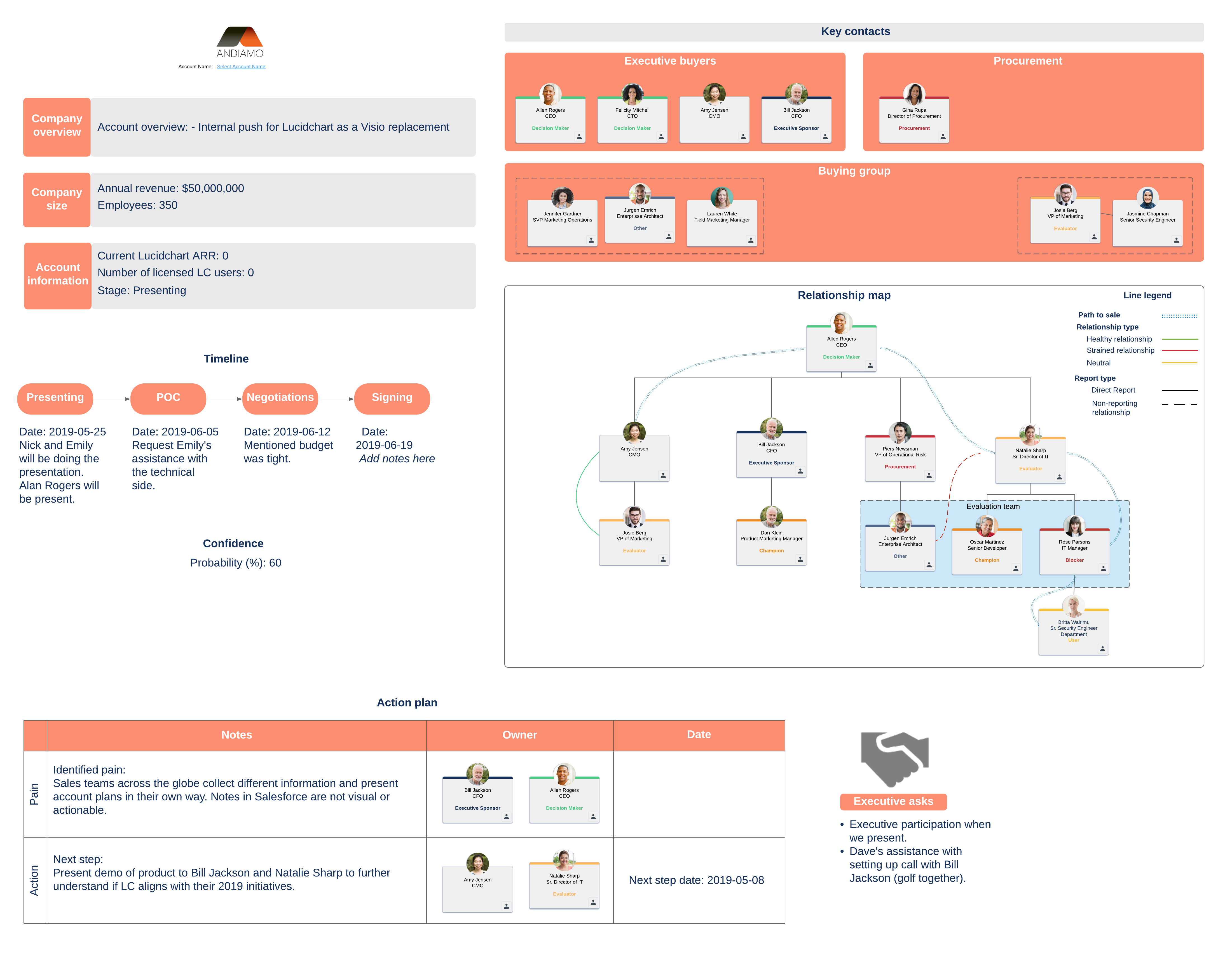
Make sure that sales reps pull data directly from your CRM so all documentation is consistent. We recommend that every sales rep covers the following material during a deal review, in addition to an account map outlining key decision-makers:
- Company overview: Sales reps should set the scene and explain what the prospective company sells and what they aim to accomplish. Information such as the number of employees, annual revenue, and key technologies used will help establish potential deal size and the company’s need for your product.
- Reasons why the prospect should buy: Explain the initiatives and pain points that make your product or service a good fit for this company.
- Deal size: Review the potential deal size according to your company’s plans and pricing (e.g., number of licenses).
- Deal plan: Include action items (and their owners) that the team intends to execute in the next 30, 60, and 90 days. Based on the direction and suggestions given during the deal review, sales reps will likely add to or revise the action items listed.
- Timeline: This section should include any planned or estimated dates, including when reps will present the proof of concept and when they hope to have a contract signed.
- Closing confidence: Here’s where you’ll still get an update for your sales forecast, with the sales rep’s confidence level based on where the deal stands now.
- Challenges and executive asks: Sales reps get their opportunity to discuss places where executives and other team members can leverage their connections and provide sponsorship in order to seal the deal.
Every deal is a little different, so it might require you to look at different metrics. However, in creating a template, you can set appropriate expectations for everyone in the deal review and focus on building an action plan. Because Lucidchart is connected to the Salesforce account record and easily accessible, sales reps can build out their slide deck with all this information directly within a visual workspace.
Create a page for each topic or add slides around key information you’d like to highlight and use presentation mode. Once your org has found the right layout and included any branded elements, you can create and share a template for all sales reps to work from.
Record action items in your CRM
Even the most optimized deal review will be a waste of time if it’s treated as a one-and-done activity. Too often, reps and managers leave the meeting without clearly defining next steps, which ultimately make learnings and results from the deal review inconsequential.
Ideally the deal review is primarily focused on “what’s next,” providing a key opportunity for managers to provide coaching and identify areas for improvement in the deal strategy. By the end of the review, the rep and manager should have decided on a revised strategy and identified all the necessary next steps to implement those improvements. If these steps are not clearly defined, reps can forget or become distracted with one of the many other accounts they are working—they need to be accountable for specific tasks.
Managers can help reps define action items by asking specific “how” questions. Doing so will help reps come to their own understanding of what needs to be done to close the deal, increasing buy-in and commitment. Next steps should be recorded in your CRM, but according to research from InsideSales.com, less than 18% of reps spend time in the CRM because of how frustrating it is to work with.
Reps should record the resulting action items and their timelines for completion at the end of the meeting. This documentation provides everyone on the team with better transparency into the strategy of the deal, and this transparency makes reps feel more accountable to actually follow through.
Sales ops should optimize the CRM so it’s easier to complete this documentation. Reps can make notes in real time directly on their Lucidchart account maps during the deal review, and these notes will be automatically synced back to Salesforce. Similarly, any documentation in Salesforce will sync back to the account map. This approach allows reps to make notes within the context of the deal rather than as isolated events.
Even after setting action items, the deal review process is not complete. Managers should follow up with reps on these action items by discussing them in subsequent deal reviews /or checking in with the rep periodically to ensure things are moving along. As part of this follow-up, reps and account managers should also determine if the steps taken have achieved the desired results or if the strategy needs to be adjusted once again.
Take advantage of executive connections
With how difficult B2B sales has become, sales professionals are no longer the only ones responsible for selling. It’s a cross-functional team effort, which is why you sometimes need to pull leadership into your deal review to gain the support necessary to take an account to the finish line. These executives bring a new perspective and often have powerful strategic connections you should be taking advantage of.
Reps should come into the deal review with key contacts already identified and documented in the account map. The deal review is where you can discover that your CEO used to work with the CIO of your customer’s company and that your CMO went to business school with the director of sales.
Executive sponsorship should be reserved for your most valuable accounts, whether that be in terms of current revenue, account retention, potential growth, strategic value, etc., and you’ll need to carefully match executives to these key accounts. Sales leadership doesn’t have time to be in the weeds of each and every deal. They’re not aware of the key players that you have spent so much time investigating, so they aren’t going to be able to identify those relationships they can leverage right off the bat.
Using the power of account maps and LinkedIn Sales Navigator, you can better understand whom to reach out to next and help executives determine the best strategy for going about this outreach. Just like with your reps, it’s important to follow up with an executive sponsor after the deal review. Keep them updated on a deal’s progression in case additional outreach on their part is necessary.