Like weather forecasting, sales forecasting is an imprecise art. But you can still make valuable predictions or narrow the margin of error. Follow our guide and learn how to forecast sales accurately, including factors to consider and common methods to use.
What is sales forecasting?
Sales forecasting is an essential component of business planning and strategy. At the basic level, a sales forecast predicts how much business a person, team, or organization will close within a given timeframe.
Companies use sales forecasts to inform business decisions, including budgets, hiring plans, marketing strategies, and inventory management.
Without a clear picture of sales outcomes, the company’s budgets, expenses, growth strategies, and resource management can fall apart. At its worst, this can mean significant profit losses, cash flow problems, layoffs or even bankruptcy.
On the other hand, good sales forecasting can help teams and organizations make sound decisions, manage resources appropriately, and even identify potential issues early and course correct.
Factors that can influence your sales forecast
Even the best forecasts are subject to internal and external factors. Take a look at a few variables that could affect your sales projections.
Personnel fluctuations
Changes in team numbers and dynamics can significantly affect sales outcomes. For instance, if a sales rep leaves, your sales will almost certainly fall until you can replace them and get the new rep ramped up.
Economic conditions
When forecasting, it’s important to account for the economic climate. A booming economy tends to deliver prospects who are more confident and willing to invest. However, a slow economy leads to slower sales cycles and prospects who need more encouragement.
Competitor changes
Unexpected changes in the competitive market can make or break a sales forecast. For example, if your competitor reduces rates or adds value to their comparable product offerings, your reps may have a harder time closing opportunities. They might need to offer bigger discounts or sweeten the deal with added services.
Product changes
Usually, product changes translate to better sales by offering improved product features, a more attractive pricing model, or other benefits. These changes can help reps sell more, faster. Just make sure the team is informed on prospective product changes so they can prepare and adjust their selling strategies and hit the ground running at launch.
Common sales forecasting methods
You can project sales in several ways. Here are some of the most common methods and how to forecast sales with each.
Opportunity stage
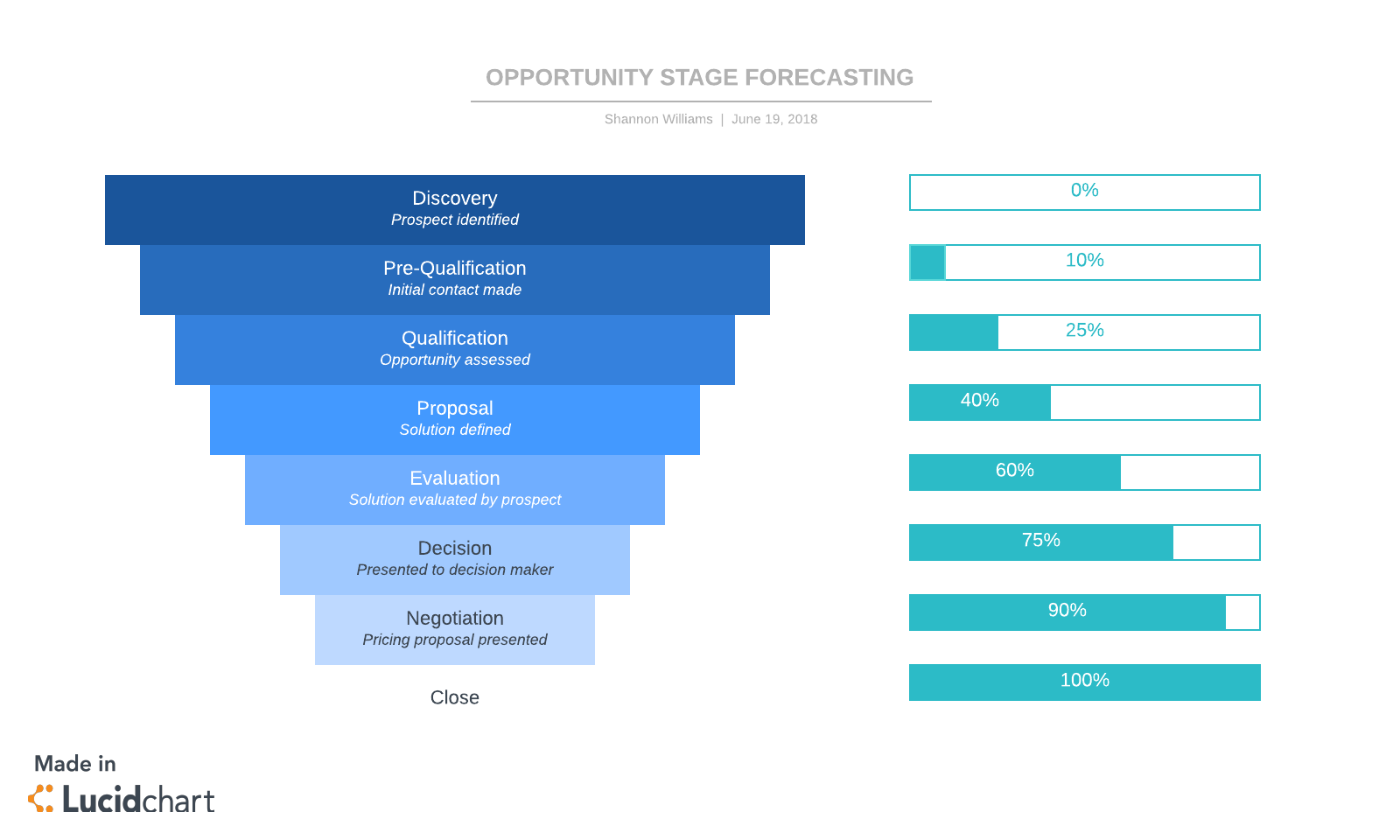
This forecasting method predicts the probability that an opportunity will close based on where the prospect is in the sales process.
The further along the prospect is in the funnel, the more likely the deal will close.
When creating a forecast, the salesperson will look at each opportunity and identify:
- The stage the prospect is in
- How likely they are to close
- The value of that opportunity
To be successful, the sales rep needs to understand the average sales cycle and have a clear outline of each stage of the sales process to make a reasonable prediction.
Under this model, you can estimate the expected revenue by multiplying the deal amount (or value of the opportunity) and the probability of closing. For example, if a prospect is being nurtured toward a $100 opportunity and has a 20% probability of closing that deal, the forecasted revenue is $100 x .20 or $20. Whereas, another prospect further down the sales funnel on a $500 opportunity with a probability of 45% would forecast at $225 in expected revenue for the projected timeline.
You can use Lucidchart to illustrate this methodology as you train sales reps or to have them visualize the probability of closing on each account.