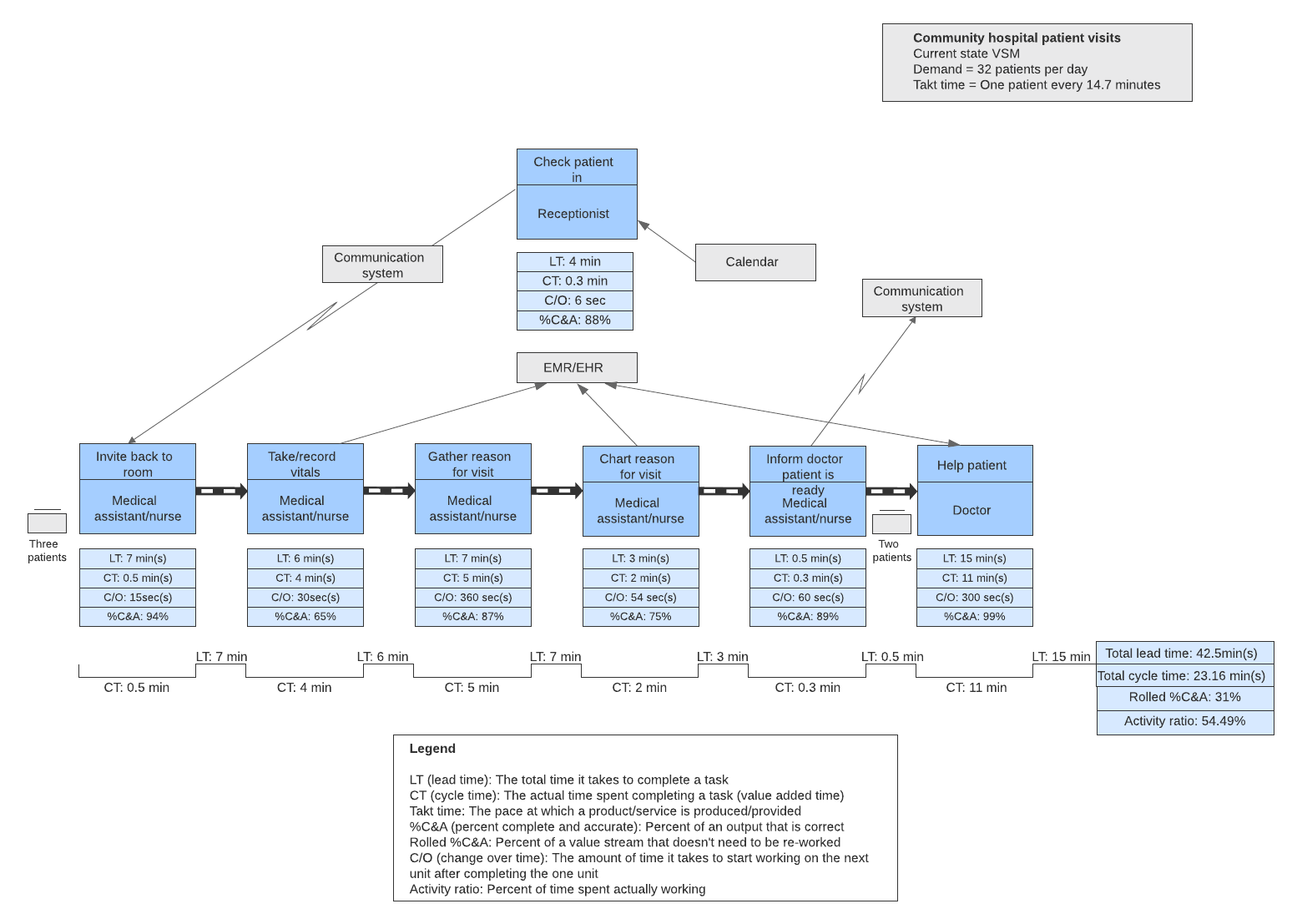
Get the big picture view of your process from start to finish. That way, you don't risk focusing too much on a single area and optimizing it at the cost of another step in process.
Identify the root cause of problems and bottlenecks
Once you have put together your current value stream, you can identify the problems in your workflow and investigate their root cause.
To find out what’s currently causing problems, perform a root cause analysis with a cause-and-effect diagram. Also known as fishbone diagrams due to their shape, they identify problems within different areas of your business. For example, service industries typically look at the four Ps—policies, procedures, people, and the plant/technology—to find potential causes.
 Detailed Fishbone Diagram Example (Click on image to modify online)
Another way to tease out the cause for a problem is the 5 Whys analysis. Suited to somewhat difficult but not overly complex problems, the 5 Whys analysis takes a problem and ask “Why?” five times, each time trying to dig deeper into the answer until the original cause comes to light. If multiple causes arise, then the problem might be too complicated for this approach and would likely benefit from a cause-and-effect analysis instead.
3. Remove waste to create flow
Before you can make improvements and create flow in your process, you need to visualize and remove waste. That sounds like a simple step, but both Lean and Six Sigma teach that inefficiencies can sometimes be hidden, which is why it’s so important to first know what counts as waste and then understand how to reduce variations.
Remove waste and non-value added steps
Combining the two methodologies, waste in Lean Six Sigma is both anything that doesn’t add value to the final product and anything that doesn’t meet the customer’s expectations. That leaves a lot of room for things to go wrong and areas that need improvement to get overlooked.
To be more proactive about removing waste, try these five steps from Rene T. Domingo, professor at the Asian Institute of Management.
Step 1: Make waste visible.
If you don’t see waste, then you can’t eliminate it. Remember, there are many different kinds of waste according to Lean manufacturing, including defects, overproduction, waiting, non-utilized talent, transportation, inventory, motion, and extra processing.
Step 2: Be conscious of the waste.
Acknowledge waste as waste. For example, we might take it as a matter of course that we’ll be kept waiting at a doctor’s office or a hospital. But that is waste that could be eliminated by having a better scheduling system, sorting patients more efficiently at check-in, or hiring more personnel.
Step 3: Be accountable for waste.
Embrace the principles of Lean Six Sigma, and encourage a culture of responsibility and ownership in your organization. No one wants to be a source of inefficiency, but if everyone on the team focuses on reducing waste, then you’ll foster a culture of accountability where everyone is working for the same goal.
Step 4: Measure the waste.
This step is important for getting buy-in from both team members and executives. Change, especially in larger organizations, can seem more costly than keeping the status quo, and employees also won’t be motivated if the waste seems trivial. It’s hard to eliminate waste if you don’t know the full extent of it.
Step 5: Eliminate or reduce the waste.
While it may be tempting to stop at this stage, this should be an ongoing process of review and revision. Adding new employees, changing or making new products, offering new services, changing locations, etc.––there are always more opportunities to cut waste and optimize your business.
Reduce variation and increase standardization
Borrowed from the principles of Six Sigma, reducing variation and increasing standardization makes it possible for organizations to be more cost efficient and have higher customer satisfaction.
Getting things right every time––or almost every time––can be challenging, so here are a few ways to get started:
-
Document your processes: As mentioned previously, you won’t know how to improve, optimize, and standardize without a clear view of how things are currently done.
-
Establish and share best practices: Reducing information silos also benefits your processes; encourage the sharing of good ideas throughout the organization.
-
Create checklists for processes so everyone knows and follows the same steps: This will make it much easier for new employees to get up to speed while also reducing errors that existing employees are likely to make.
-
Make sure everyone gets the same training: Getting your processes working just right means that all your employees need to be on the same page.
-
Use forms and templates: This greatly reduces confusion for employees when creating reports, responding to customers, logging errors, etc.
-
Automate anything that’s repetitive, boring, and therefore error-prone: Speed things up and make them more precise by replacing some manual tasks, especially if there’s an online application or tool that can do it better.
4. Communicate with your team
People don’t like change, which means that in your organization, your employees will likely keep doing what they’re doing unless management tells them otherwise. The onus is on the business to effectively, clearly communicate new standards and practices. Be sure each employee receives training and feedback on the new processes and procedures. Otherwise, why expect the problem to change?
Ways to communicate and disseminate information include:
- Creating new knowledge by putting a knowledge base in place or updating your existing knowledge management system
- Updating your customer support knowledge base
- Making the full process easily accessible for stakeholders and employees according to their specific role
- Creating process maps that show your employees what has changed about their workflow