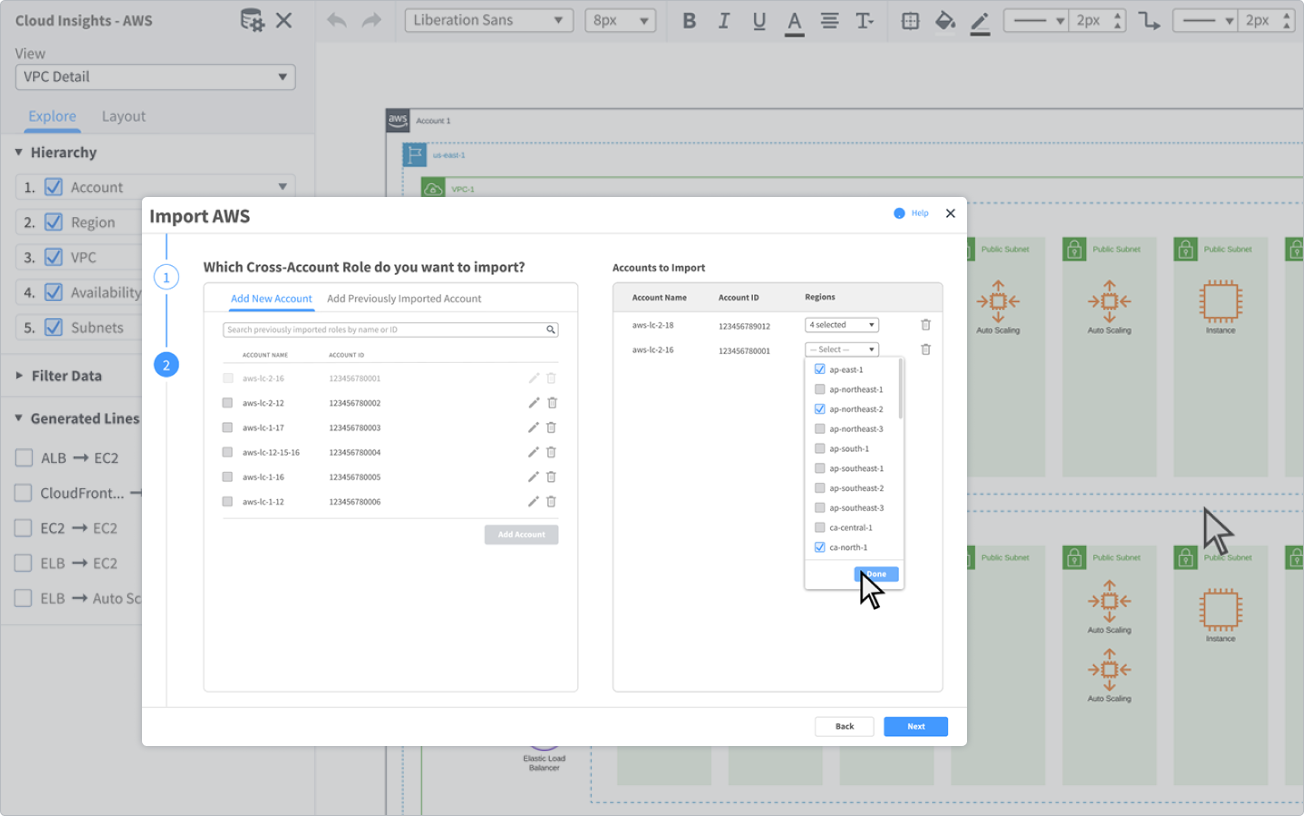
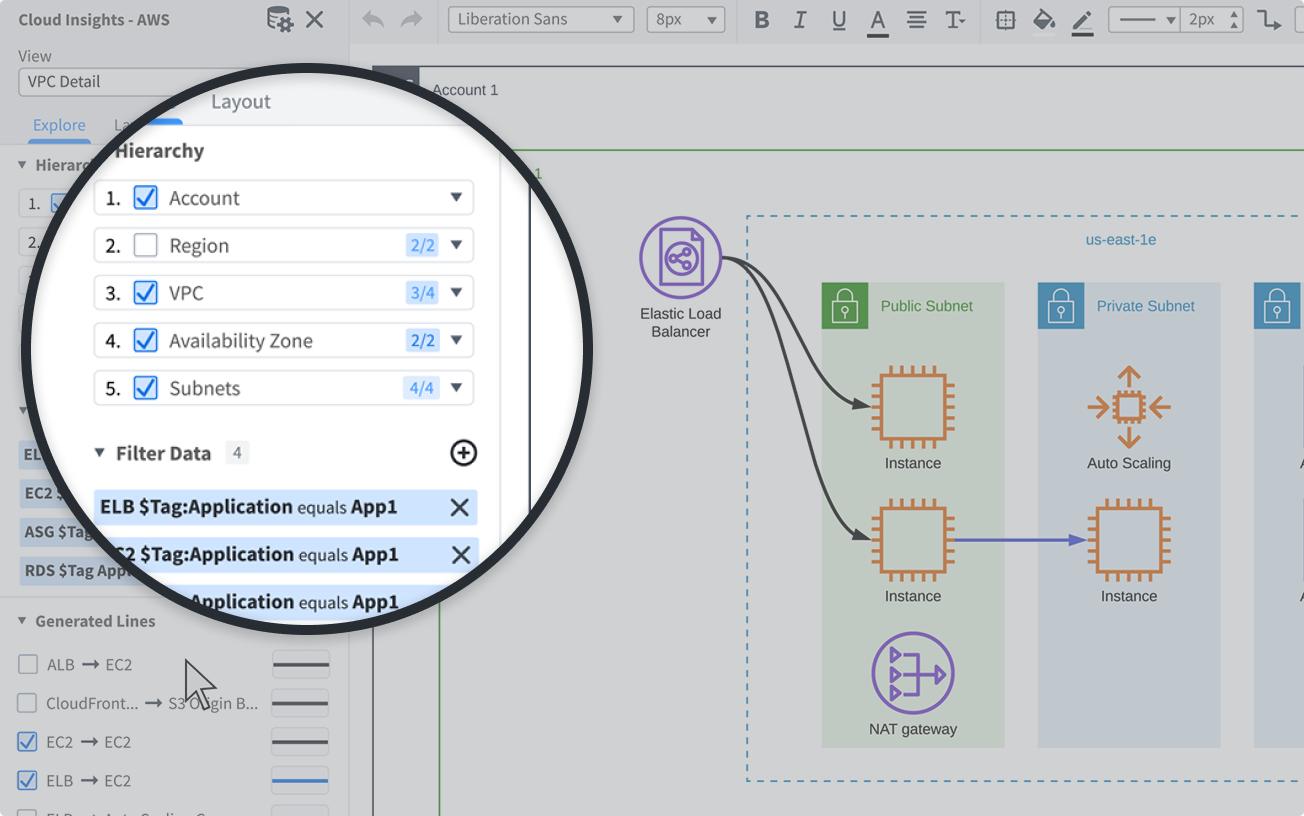
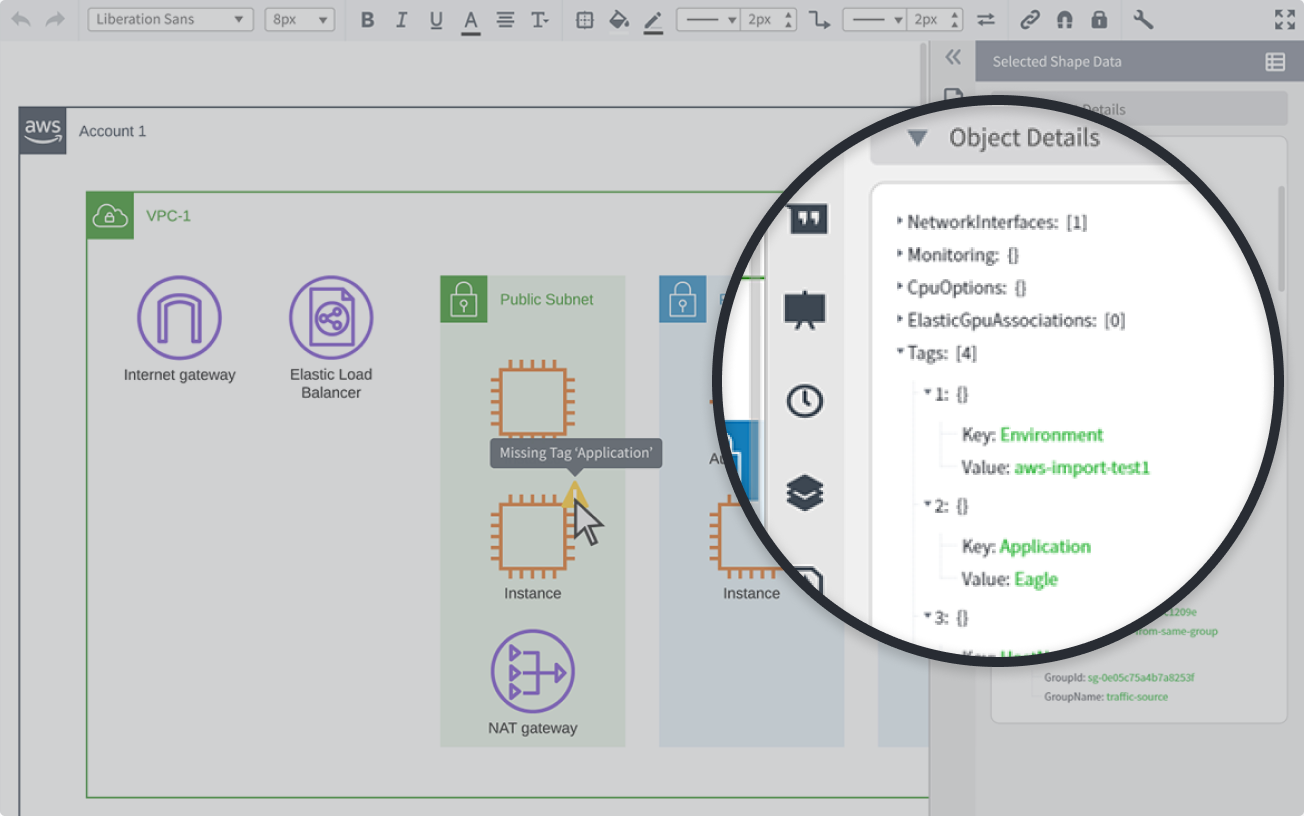
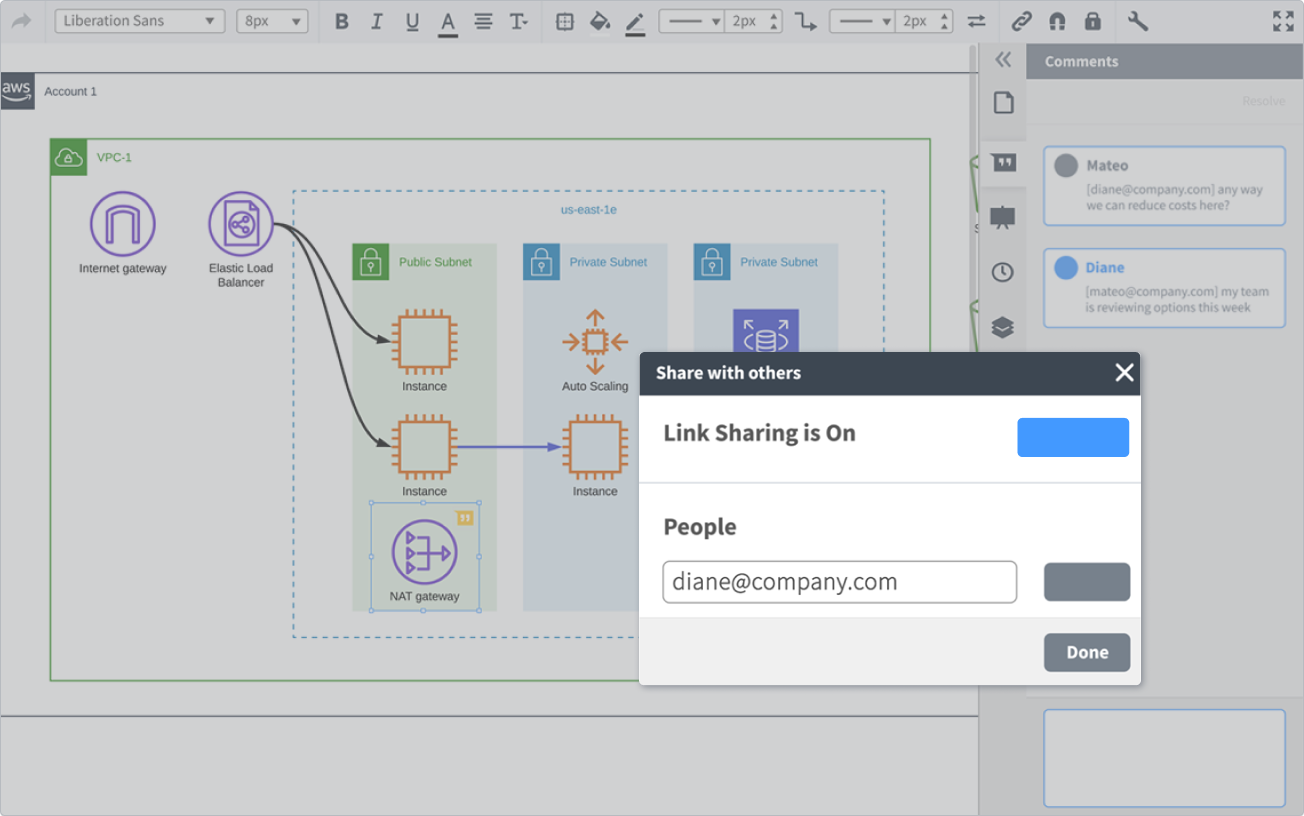
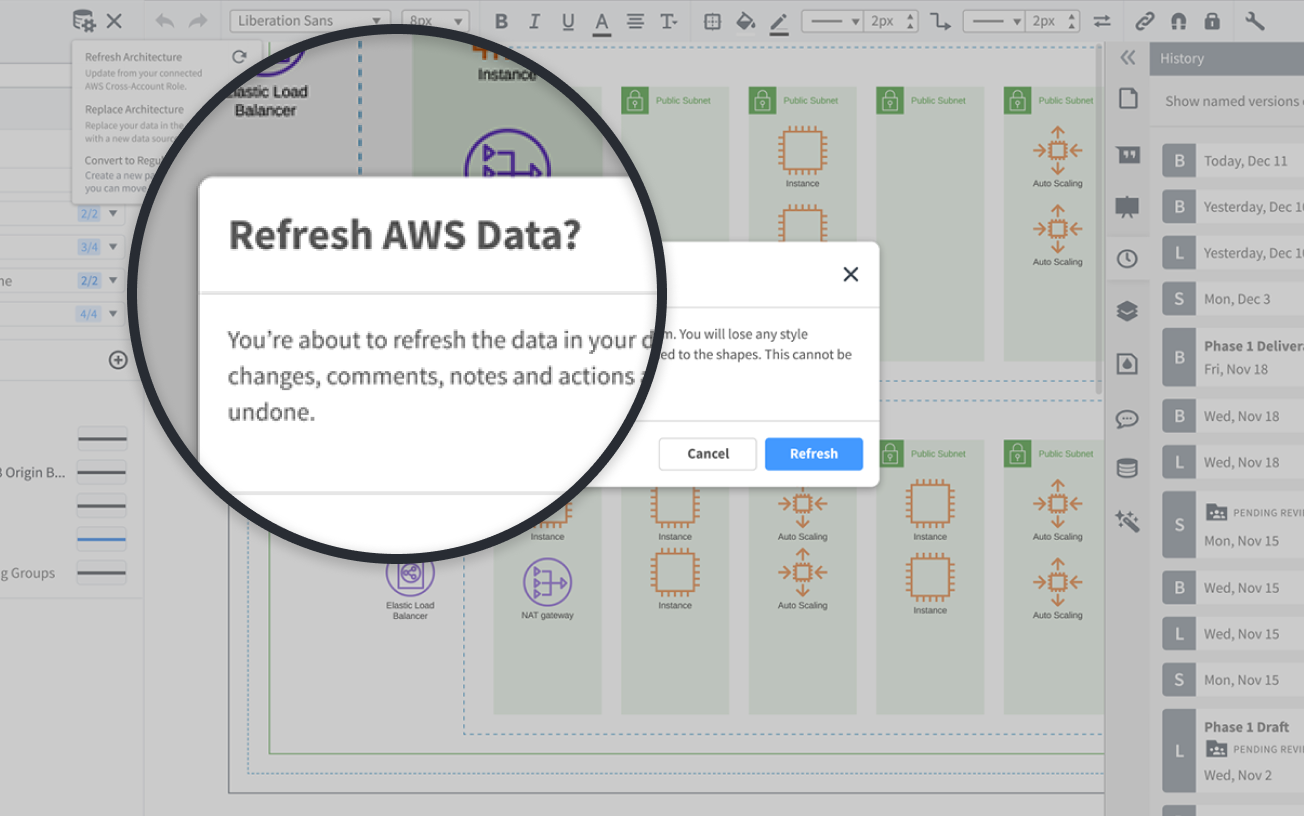
Now you can rest easy knowing your teams are working with an accurate depiction of your environment. You can even easily look back to see how your infrastructure changes over time with our revision history feature.
What can you do with Lucidscale?
Lucidscale was built to address multiple challenges that cloud architects and engineers have. With Lucidscale, you can:
- Understand your infrastructure quicker.
- Resolve incidents faster.
- Confirm cloud migration or implementation was done correctly.
- Review the security and compliance of architecture.
Understanding your infrastructure quicker
When you automatically create architecture diagrams with Lucidscale, you can quickly extract insights to make smarter cloud decisions. Within a few clicks and minutes, you can:
- Understand your current infrastructure, so you can plan a vision for the future.
- Be aware of current limitations, ensuring what you develop and deploy will work with what exists today.
- Onboard new team members without relying on tribal knowledge or digging through code and consoles.
- Validate that what actually exists aligns with what you think exists.
- Ensure your diagrams are available and accessible from anywhere.
Lucidscale mitigates the risks and worries of blind spots, tribal knowledge employees leaving your company, or essential information being out of date and inaccessible to those who need it.
Resolve incidents faster
When an outage happens, using a visual to work off of can significantly reduce downtime. When accurately and constantly kept up to date, network diagrams are a single source of truth to reference and explain when an issue arises. However, the problem is, up-to-date diagrams are often not available or accessible when something goes wrong.
Lucidscale makes it easy to keep your architecture diagrams up to date and centralized, so teams can:
- Determine where a problem is occurring.
- Identify what the issue is.
- Understand why a problem is occurring.
- Understand how the associated systems are connected.
- Decide what to communicate to involved or affected teams.
Confirm cloud migration or implementation was done correctly
Deploying something into the cloud often passes through many hands, and you hope plans are not lost in translation. For example, architecture can be designed by a cloud architect, reviewed by security teams, passed to an infrastructure engineer to write infrastructure as code, and potentially pass through more employees or teams for quality assurance.
Lucidscale helps you tackle two very important tasks during implementation:
- Verifying that migration and implementation was done correctly.
- Understanding why migration and implementation were not done correctly, if that happens.
Essentially, Lucidscale helps you quickly cross-check plans with what your engineers actually build. Compare your “blueprint” diagram with your current state diagrams—if the diagrams are not identical, you can direct stakeholders to the exact location of misalignment and prompt conversations about:
- Potential engineering mistakes that need to be corrected.
- Possible technical limitations in the architect's design that may alter implementation.
In either case, Lucidscale helps you align your teams and effectively communicate as you plan and build your cloud vision. And long-term, you can stay on top of any changes that happen to your infrastructure, so when you’re ready to make a change or addition, it can be done with an accurate starting point
Review the security and compliance of architecture
Most IT initiatives involve security and compliance, with special consideration involving the cloud, undeniably meaning a handful of tasks that can take days or even weeks to complete.
Meanwhile, Lucidscale helps you tackle these lengthy tasks in just minutes, whether you need to visually cross-check your infrastructure set up, or respond to a compliance audit:
- Security: Gain visibility into what exists so you can uncover potential risks and threats.
- Compliance: Maintain and prove compliance during audits and certifications by submitting an up-to-date network diagram as evidence.
When you automatically diagram your cloud architecture, you can put manual work aside and instead focus on optimizing cloud architecture and performance and fulfilling your company’s cloud initiatives.