Getting started
As an employer, you have a legal right to conduct a background check on any potential employee. Your applicants have rights as well to protect them from discrimination. Before you jump in and start doing background checks, you need to know the rules to protect your company and your candidates.
To get started, you may want to get legal advice about:
- Release forms the applicant needs to fill out and sign
- Federal rules governing background checks
- State and local laws concerning the HR background check process
- Types of information you can look for and types of information you need to avoid
- Laws related to specific jobs and roles
- Protocol to handle sensitive information
In addition, you may want to consult with others who have been through the process to learn how other companies do background checks.
Document everything
To ensure that your HR background check process is consistent, be sure to document the types of information you plan to gather and your processes for gathering that information. You want to be sure that every applicant is treated equally and that the background check is performed the same way no matter who is doing it.
Employers are required to apply the same standards to all candidates, not based solely on the candidate’s race, national origin, sex, religion, sexual orientation, gender identification, disability, genetic information, or age (40 or older). For example, you can’t ask only people of a certain race for criminal records.
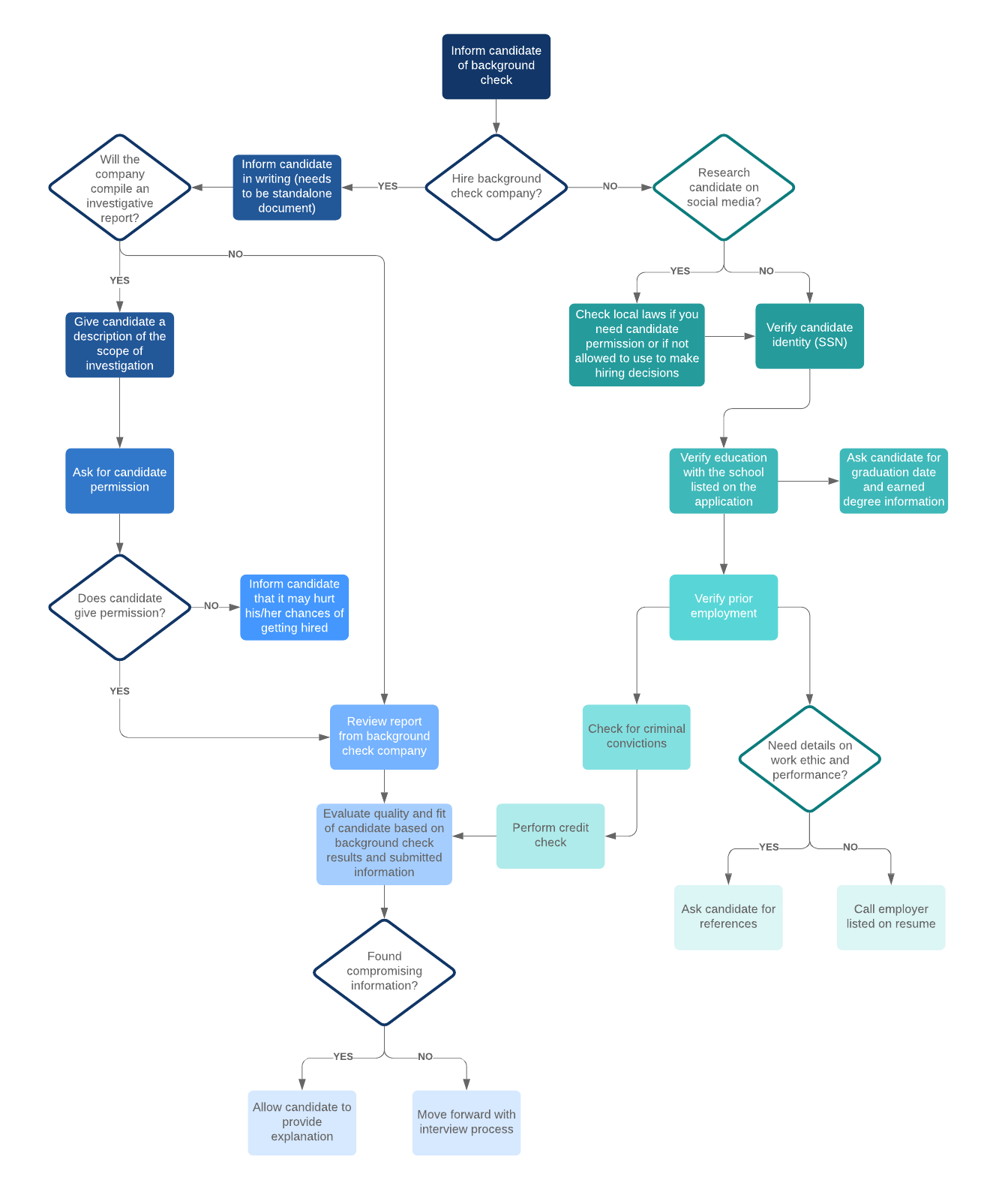
To make sure that your employee background check process is consistent, document each step in the process in a flowchart. Or, you can create a chart that you can quickly reference specific laws and rules governing background checks in different states and locations.
Lucidchart has an extensive template library that you can use to create any type of diagram or visual that will help you define your process.
Get permission
No matter where you live and work and no matter where your applicants live and will be working, federal law requires that you inform them about background checks. The law also requires that you have permission from the candidate to perform any background checks.
If you hire a company that specializes in performing background checks, the Federal Trade Commission (FTC) requires that you inform applicants that the information gathered might be used to make hiring decisions. You have to inform the candidates in writing, and the notice must be a standalone document that is not included in the application.
If the company you hire compiles an investigative report about a candidate’s general reputation, personal characteristics, and lifestyle, the law requires you to give the applicant a description of the nature and scope of the investigation. That permission must be in writing and must be signed by the applicant.
If a candidate doesn’t give permission, that is okay. You can’t require an applicant to give you permission as part of your interviewing or hiring process. However, it is legal to let candidates know that not allowing a background check can hurt their chances of landing the job.
Be careful with social media
You don’t need permission to search for a candidate online. You can type a name in any search engine and easily find information without signed waivers or permission forms. However, many states are adopting legislation that prohibits an employer from searching social media even if the candidate gives permission. Other states prohibit employers from using the information acquired from social media to make hiring decisions.
If you choose to use social media, don’t get too close to the candidate. Don’t ask for Twitter handles or to be friends on Facebook. A person’s lifestyle or political views rarely have anything to do with their ability to perform a job. Don’t let what you see posted on social media cloud your judgment or lead to discrimination.
In addition, avoid looking up a candidate before an interview is scheduled. You don’t want to form a first impression without first actually meeting either on the phone or face to face.