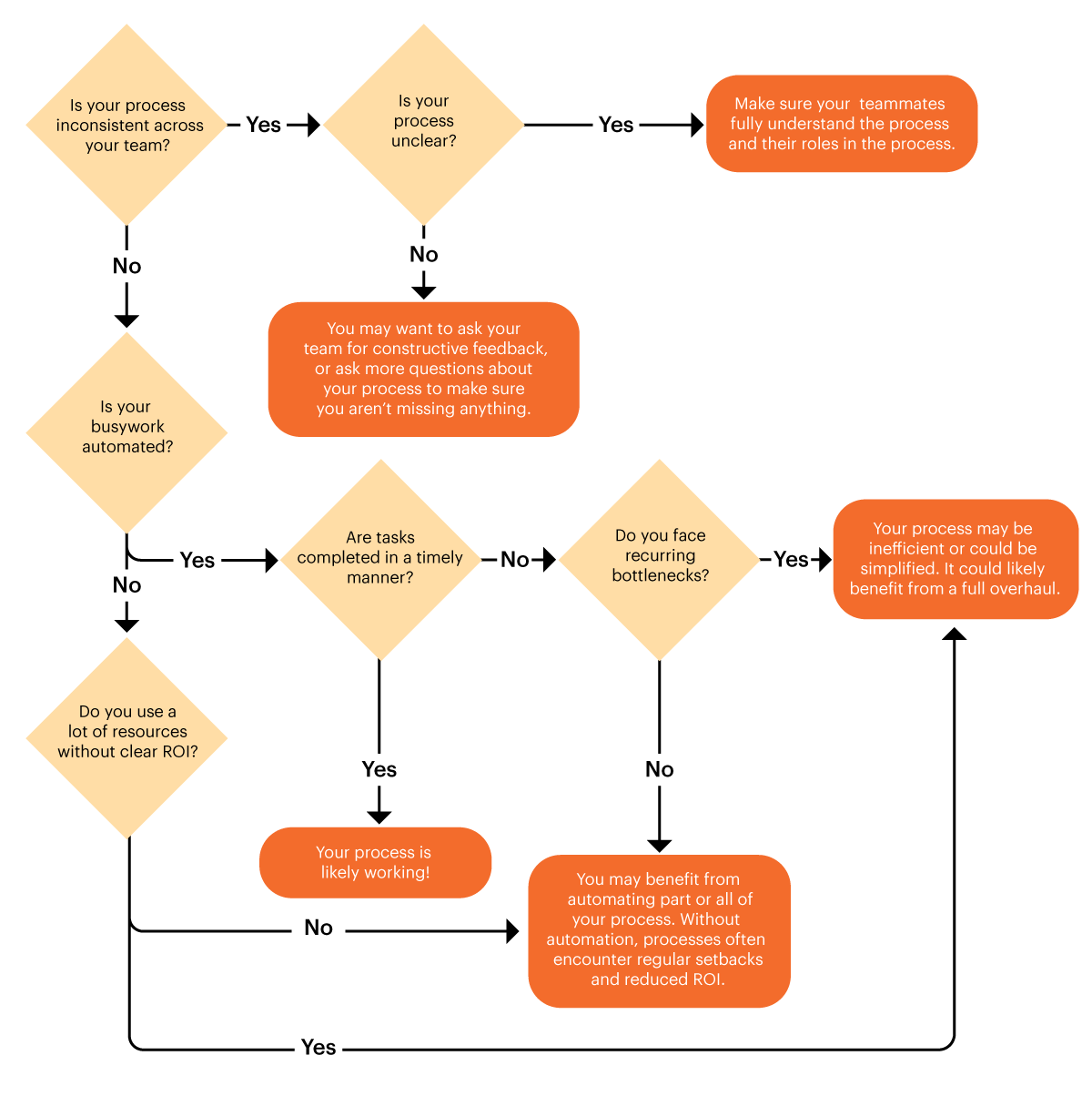
Because it’s not always immediately obvious where a process needs improvement, sometimes you just need to sit down and systematically walk through different aspects of the process. Asking the right questions can help you sort out whether your process is totally flawless or still has areas you could improve.
Regardless of what motivates you to revisit your process, take the opportunity to look critically at what is and isn’t working.
How to think about process improvement
Process improvement usually doesn’t happen overnight. If you can catch a process problem before your process entirely breaks down, you’re in the strongest position to improve it. Broken processes can be more difficult to troubleshoot and repair. As your team becomes accustomed to running a process in a particular way, making meaningful change becomes significantly more difficult. A continuous improvement approach can help your team maintain a consistently effective process.
As-is process analysis
Before you can begin repairing your process, it’s time to critically examine where your process is at right now. As-is process analysis is a technique that reveals where your business process has weak areas and potential places for improvement. Every process has aspects that can be adjusted or modified, providing you with built-in factors you can change in order to strengthen, streamline, or improve it.
To get started, you’ll need to diagram your process, walking through each step and unpacking what each part of your diagram depicts. With your diagram, you can consider these six facets of your process:
- Business process design: The design aspect of your process features steps, handoffs, team member roles, decisions, and sequence elements. As you consider the design itself, make sure each step, actor, sequence, intermediary, and approval actually make sense.
- Technology and information systems: Any underlying technology and information systems that your process relies on should be reassessed to fit in your process and for their contribution to process success. Unnecessary re-entry of data, missing functionality, outdated technologies, or excessive complexity can cause your process to struggle.
- Motivation and measurement: The metrics you use to measure your progress may themselves need reassessment. It’s important to make sure that you are measuring appropriately, focused on the customer, measuring outcomes and not only tasks, and incentivizing the right behaviors.
- Human resources and organization: Make sure that your team members are in the right roles for their skill sets. Look for mismatches and make sure your recruiting fits your current needs. Employees should feel fully empowered to take ownership of their work. If your process requires specific roles in order to hold together, be sure to make a note of this.
- Policies and rules: Any rules that aren’t actively based in legal, regulatory, quality control or industry standards should be reconsidered to see if they really add value or if they actually slow your process down. Look for policies that are out of date, unnecessary, inconsistent, conflicting, or don’t originate from a clear source.
- Facilities: The location online or offline where your process occurs is worth evaluating to ensure that it still meets your needs. The layout shouldn’t interfere with your work. Processes built around facility layouts and limitations instead of around optimal workflows may be impeding your efficiency and progress. Furthermore, facilities should generally relate to how your workflow operates.
Using these categories and facets, carefully review your process for weaknesses, drawbacks, or deficiencies. You may immediately recognize areas where your process can improve, or it may take more thorough consideration alongside your teammates to come up with tangible improvements. Regardless, taking the next step and carefully examining your process can yield helpful opportunities.
Improving your process with critical questions
In addition to leveraging as-is analysis, following a step-by-step checklist for business process improvement may reveal what you need to transform your process. Get started by asking yourself the following questions.