Sales compensation plans are the most significant driver of success in sales operations and also one of the biggest financial investments of the organization. With such high stakes, it’s crucial to get your plan right.
But what does that mean? And what does a successful commission plan look like?
Sales compensation plans need to be designed strategically in order to drive the right sales and elicit the desired behaviors from your reps.
While the right plan will look different for every organization, review these steps and best practices to follow when structuring your own sales compensation plans.
Note: Much of this article is based on thought leadership from Jacco van der Kooij, the founder of Winning By Design. Learn more about our new partnership with Winning By Design, which includes exclusive Lucidchart templates.
How to design a strategic compensation plan
Ready to get started? Follow these steps to build out a compensation plan for your sales org.
1. Establish business objectives
Before you begin to crunch numbers and dig into sales territories and roles, you have to start at the very top. The best sales compensation plans are strategically aligned with the organization’s objectives.
You first have to identify exactly what your business objectives are. Work with executive stakeholders to understand the business’s strategic goals so you can design a plan that focuses on measuring and incentivizing performance that will actually support those objectives.
2. Identify sales roles
With the business strategy in place, you can now hone in your sales force. Identify the sales roles within the organization that you will include in the commission plans (e.g., hunters, farmers, channel partners, etc.). Each sales role will need a specific compensation plan.
Some common customer-facing sales roles include:
- Sales development representative (SDR): Focuses on prospecting.
- Account executive (AE): Focuses on sales acquisition.
- Customer success manager (CSM): Focuses on onboarding and training the customer to get the most value out of the product/service.
- Account manager (AM): Focuses on renewal, upsell, and cross-sell from existing customers.
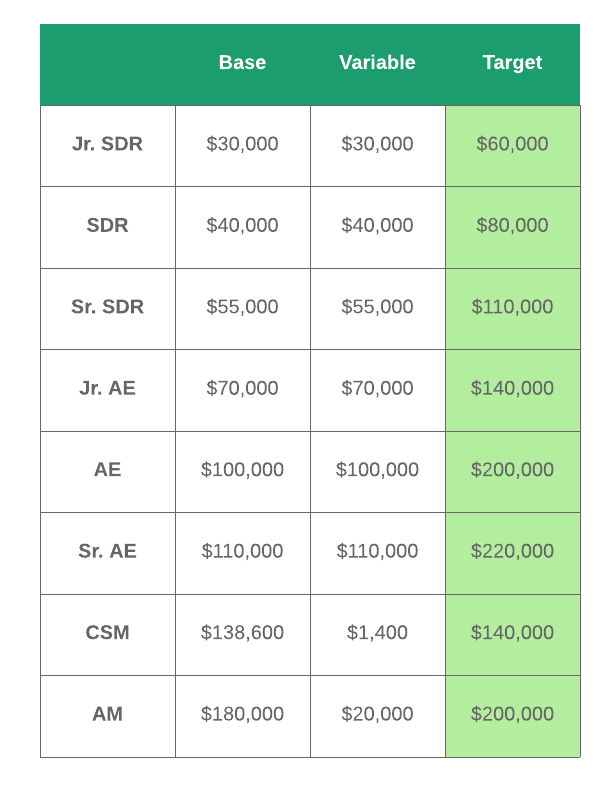
Within these roles, you can create junior and senior positions to fairly compensate employees with entry-level positions and more experienced employees who are focused on larger, more strategic deals.
3. Define and align your sales objectives
Next, you must define and align your sales objectives. For instance, your sales objectives might include one or more of the following:
- Expand market share by X amount
- Win # of new accounts
- Introduce new products
- Increase revenue by Y amount
For your compensation plan to be successful, you need to know exactly what your sales goals are so you can create incentives that support those initiatives.
Keep in mind that your sales objectives should be closely aligned with your aforementioned business goals. By strategically aligning your business and sales objectives, you can ensure your sales force is driving success at the organizational level.
4. Determine pay structure
Here’s where we get to the meat and potatoes. With your business and sales goals aligned, you can drill down into the specific structure of your compensation plan. To do this, you will need to determine target pay, pay mix, and upside potential for each sales role.
Target pay
The target pay (also called total target compensation or on-target earnings) is everything the company provides to the employee including base salary, commission, bonuses, and perks. This number will help you budget and break down the rest of the commission payout.
Pay mix
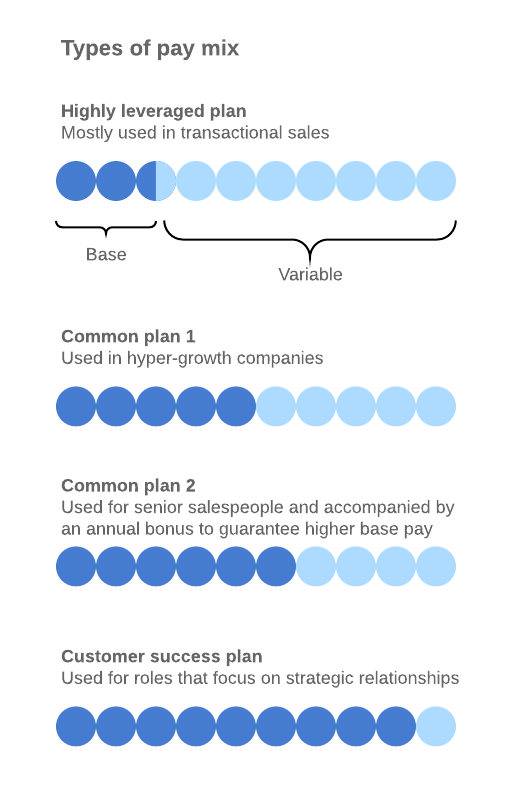
The pay mix is the ratio of base salary to target incentives that make up the total target pay. For example, a 60/40 pay mix means 60% of the employee’s compensation package is a fixed salary and 40% is potential earnings from incentives.