Principles of strategy mapping
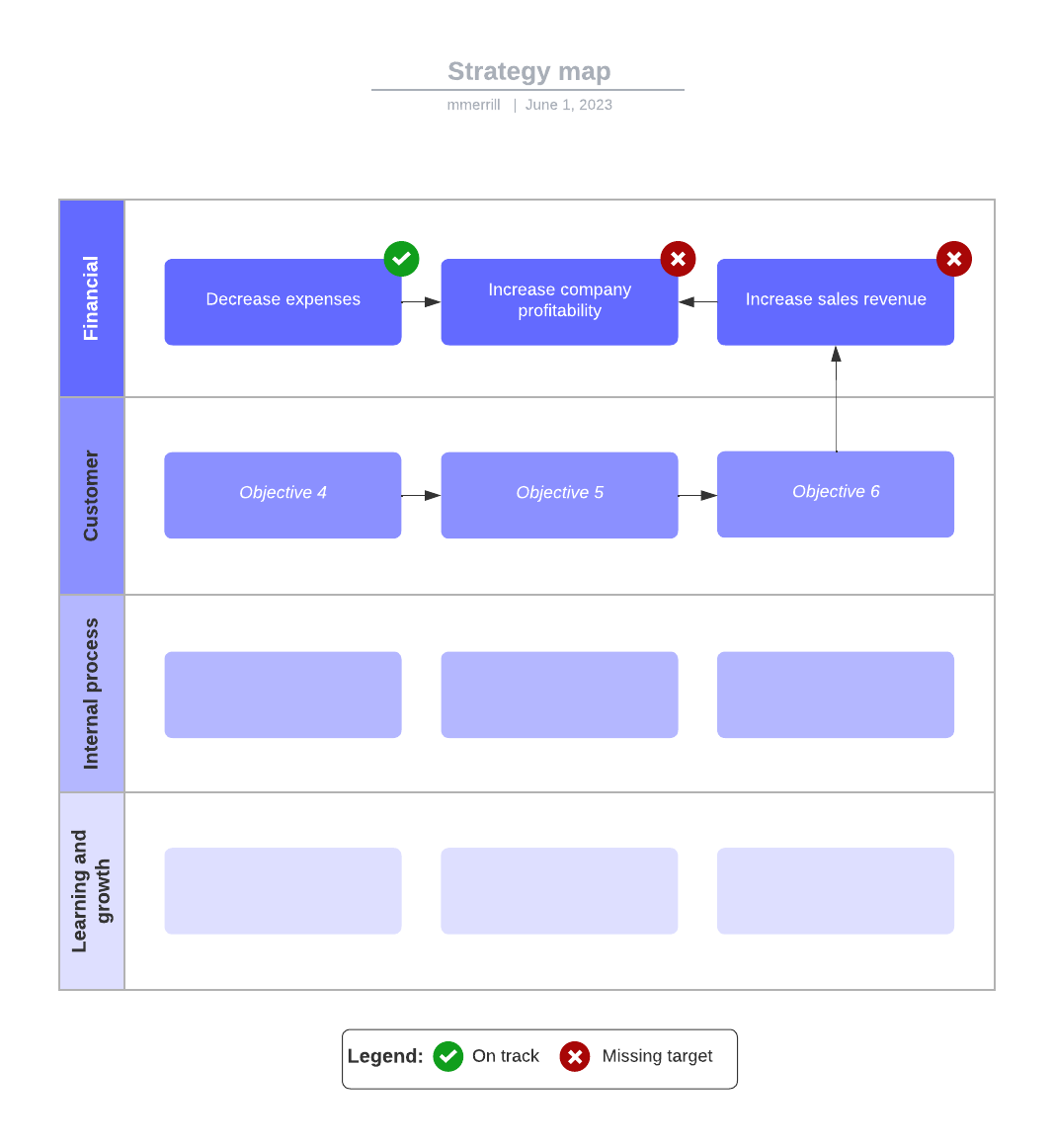
Simply put, a strategy map is a diagram used to document a team’s primary goals. A strategy map can and should be created for your organization as a whole and for smaller teams whose strategy may differ. A good strategy mapping example contains all necessary information on one page and visualizes the cause-and-effect relationships between the company’s and customer’s perspectives.
Before building a map for your company using a strategy map template, you should understand the basic principles of strategic mapping, outlined below.
Balance contradictory forces
Because your strategy map takes into account both what your business wants and what customers want, your strategy must balance consumer wants and needs with the interests of your organization.
Differentiate a customer value proposition
A good strategy is not only about business performance but also about giving customers what they need. In developing your company’s strategy, you should define what makes your organization’s offering different from what other companies provide.
Create value with internal business processes
When mapping your strategy, keep your internal business processes in mind and think about how they separate you from other organizations. Is your team structured to get work done for clients more efficiently? Have you developed a new way of manufacturing a product? Do you use data in new and exciting ways? Make your advantages integral to your strategy and not just added bonuses.
Think in simultaneous, complementary themes
Because you must consider both internal and external forces when mapping your strategy, it’s important to make sure the different phases work in tandem. Think of how a project manager uses swimlane diagrams to sync workflows for multiple team members—your strategy map should sync different aspects of your business, both outside and in.
Work from the top down
Unlike many process maps, a strategy map should be designed from the top down—where you want to be, rather than where you are. Instead of starting with an idea for a new product or service, start with a financial goal and work your way back to ideation from there. The following are the four different perspectives you should consider from the top down when developing a strategy map for your business.
1. Financial perspective
Business strategy mapping puts your organization’s financial perspective front and center. For larger companies, that could be a goal for increasing shareholder value. For smaller companies, it may be something as simple as acquiring a certain number of new customers. By defining your end financial goal, you can work backward to build your strategy with that final focus in mind.
2. Customer perspective
In order to meet that financial goal, you will need a customer value proposition, a statement of how the product or service you offer differentiates you from the competition. By focusing on what your customer needs, you can build those values into the earlier stages of the strategy map.
3. Internal perspective
Now that you have the value proposition—what you will provide for your customer in order to reach your financial goal—you know what you need to build internally. What kind of work needs to be done, and how many team members are needed to do it?
4. Learning and growth perspective
In figuring out all of these steps, you learn more about your business than you would working from bottom to top. Instead of hiring a bunch of people and then finding things for them to do, you can find out what needs to be done and grow your company accordingly with your strategy in place.
Building with a Lucidchart strategy map template
Now that you understand the principles and basics of strategic mapping, you can use a Lucidchart strategy map template to map the strategy for your organization. Download a strategy mapping template and follow along, step by step, as you map out your strategy painlessly with Lucidchart’s help.