Designing IT services that meet business needs and customer expectations can be a challenge. In order to manage competing priorities, costs, risks, and responsibilities, you'll require a clear process and collaboration across business units.
What is service design in ITIL?
ITIL service design is the second stage of the ITIL service management lifecycle. Service design provides guidelines and best practices for designing new IT processes and services and preparing them for a live environment. The service management team follows the strategy defined in the first stage of the service management lifecycle to guide their design decisions and ensure services align with the overall goals of the organization.
During this stage, the implementation, integration, and impact of the new service are considered for all stages of the service lifecycle.
As a result, ITIL service design delivers measurable business value, including:
- Reduced cost of ownership
- Better (and strategic) decision-making
- Improved processes and performance
- Higher service quality and consistency
What are the four P's in service design?
There are four fundamental components in the process of service design, called the four P’s:
- People
- Products
- Partners
- Processes
If any one of the four P’s is missing from the design stage, your services will not successfully meet the needs of your business, IT, and end-users. The four P’s ensure a holistic design approach that accounts for each of these core parts so that the final service requires minimal improvement through its lifecycle.
People
People are the foundation of good ITIL service design and management, so it is crucial your team has the knowledge, skills, and resources to effectively design and implement quality services. They should also have a clear understanding of end-user needs and requirements so that the services are designed with them in mind.
Products
Products are any tools, services, and technology your team needs to successfully deliver and support your new services. As you design new services, consider what tools (e.g., automation) and technology you need to streamline the design process.
Processes
How ready is your team to implement and support a new process? Consider what processes, roles, responsibilities, management controls, and activities are required to provision new IT services.
Partners
Partners include any third-party companies, such as vendors, suppliers, and manufacturers, who work with you to support your IT services. During the design stage, consider which partners you will need to build and support your new services.
11 processes of service design in ITIL
There are eight main processes and activities within the ITIL service design stage:
- Design coordination
- Service catalogue management
- Service level management
- Supplier management
- Capacity management
- Availability management
- Service continuity management
- Information security management
Additionally, there are three unofficial service design sub-processes:
- Risk management
- Compliance management
- IT architecture management
Following all of ITIL’s service design processes and best practices results in cohesive service packages, streamlined processes, appropriate supporting systems, standard performance metrics, and clear technology architectures.
We will be going into more depth on the first eight processes, but the three sub-processes are also an important part of delivering a holistically designed service. They ensure that each service has been designed and assessed for risk and compliance issues and is integrated seamlessly with your IT architecture.
Keep reading to learn about the eight main processes and activities.
1. Design coordination
The ITIL design coordination process ensures all design processes, activities, and resources are coordinated effectively throughout the entire service design stage. It is also responsible for producing the service design package (SDP), which describes how a new or changed service should be designed, tested, and operated.
Sub-processes include:
- Design coordination support
- Service design planning
- Service design coordination and monitoring
- Technical and organizational service design
- Review and RFC submission
Additionally, service design coordination manages the resources needed throughout the service design stage to ensure they are planned, scheduled, and allocated appropriately across multiple teams and projects.
2. Service catalog management
Service catalog management (SCM) ensures that the service catalog is created, updated, and maintained with accurate and reliable information on all IT services. An ITIL service catalog documents information on all live IT services and any that are being prepared for delivery.
Your service catalog should include details such as:
- Service name and description
- Availability
- Service owner
- Prices
- Contacts
- Deliverables
- Ordering and request processes
- Service-level agreement (SLA) information
The service catalog should be divided into two primary categories: business services and supporting services.
Business services refer to all services that are visible and accessible to the end-user. Supporting services (or technical services) are any services IT needs to support the business services, and are only visible to IT personnel.
3. Service level management
ITIL service level management (SLM) is responsible for negotiating and managing service level agreements (SLAs). SLM provides a framework for defining SLAs and developing SLAs to ensure that all IT services are delivered as agreed and expected.
SLM involves several key activities:
- Identifying business requirements
- Defining the scope of services, schedules, recovery aspects, and service performance
- Translating business requirements into IT requirements
- Supporting the development of a service catalogue
- Conducting a gap analysis between business requirements and current services
- Determining the costs of services
- Drafting and refining SLAs in coordination with other business teams
- Implementing SLAs
- Measuring and reporting on SLA performance
Performing these activities ensures there is a process for continual improvement so the business can adapt their services to ever-changing business environments. SLM promotes communication and understanding between the business and customers, ensures appropriate infrastructure and resources are allocated to maintain SLAs, and improves cost management through the entire service design lifecycle.
4. Supplier management
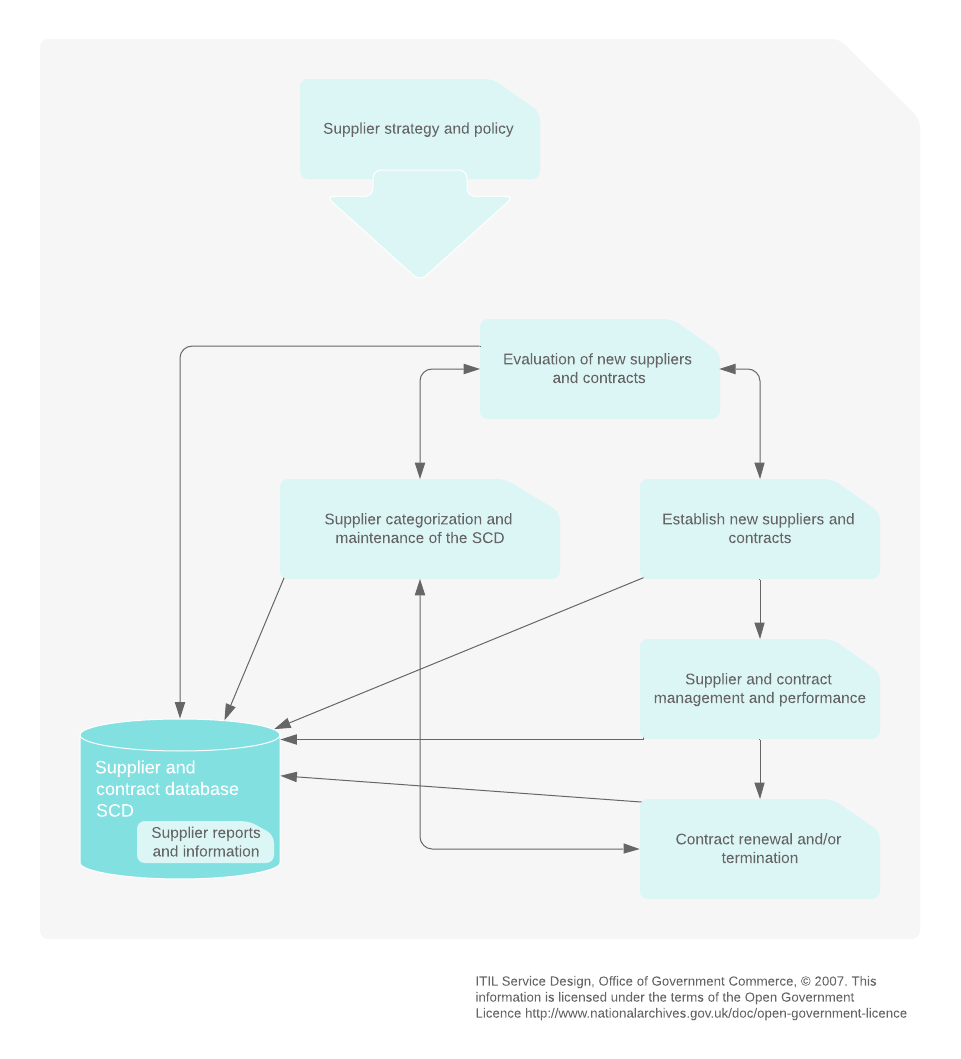
The ITIL supplier management process (formerly called ITIL contract management) focuses on managing supplier contracts to ensure they fulfill business requirements and SLAs in a cost effective way. Managers work closely with service level management and capacity management to ensure suppliers are delivering the right levels of service to meet service and quality needs.
The primary management steps include:
- Defining contract requirements
- Evaluating new suppliers and contracts and ensuring they align with SLAs and business goals
- Categorizing suppliers and contracts
- Establishing new suppliers and contracts
- Managing contracts and supplier performance
- Renewing or terminating contracts as performance and service needs dictate
Careful supplier management ensures good value for money spent and that contracts align with business goals.