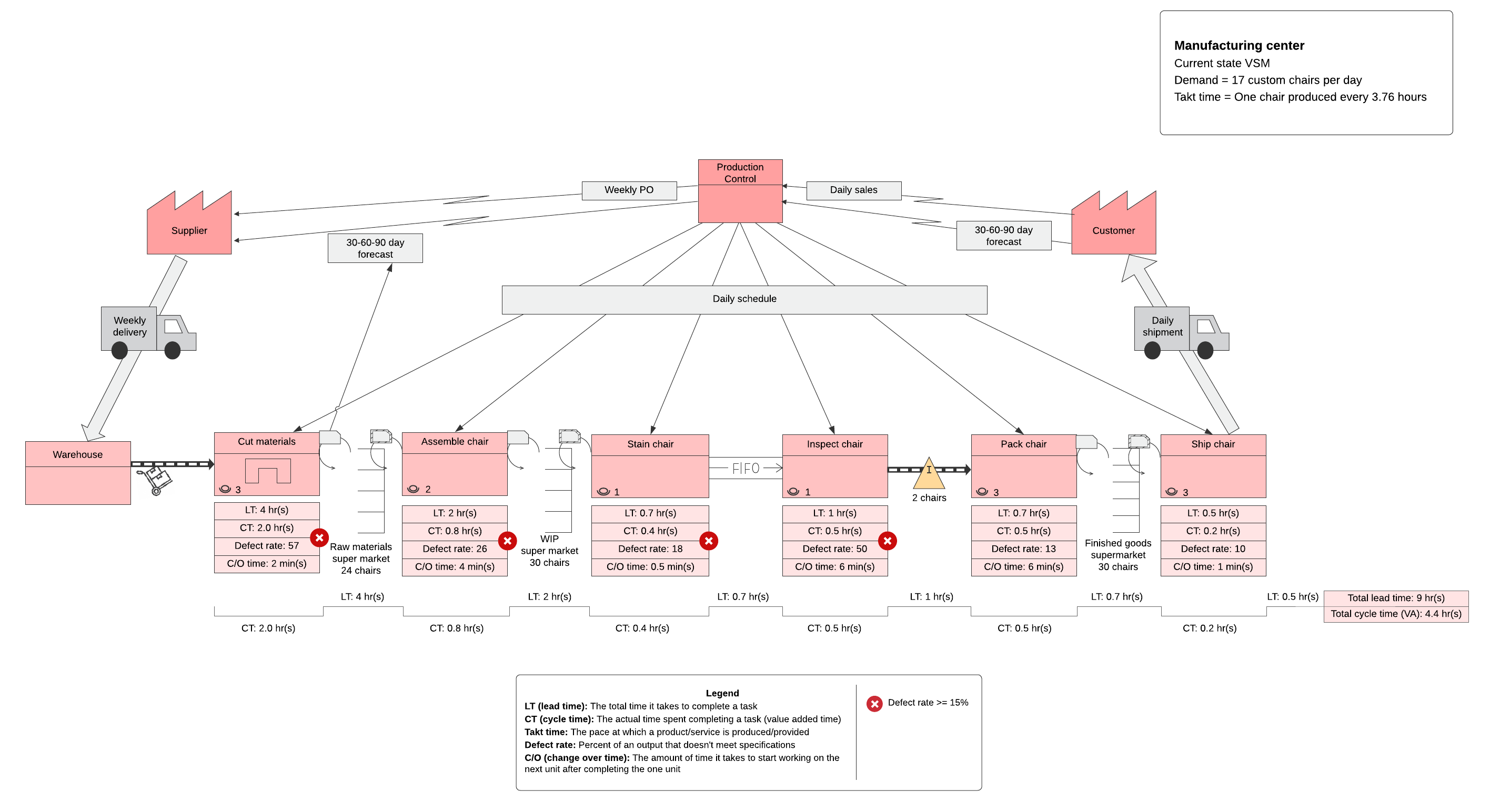
Value stream mapping (VSM) is an innate behavior for many of us: We check our driving routes to see if there’s traffic and if we can save time going a different way. We analyze our budget to see how we can increase our savings. We evaluate our jobs to see if changing roles would improve our work-life balance and income.
It’s no wonder that those principles of evaluation are also applied to how businesses deliver their products and services. This is especially important for project management professionals (PMPs), as value stream mapping is designed to identify and eliminate waste. As a project manager, using value stream mapping to find where waste is occurring in a process allows you to improve your end product. You’ll be able to improve quality and lower costs while maybe even improving the speed of production and resolving inventory issues.
VSM can be as detailed as you’d like it to be, so you’ll need to determine for yourself what your end goals are. Too broad, and the project will lose steam. Too simple, and it won’t demonstrate value to leadership. Take time to understand what you need.
For example, if you’re mapping value streams for an enterprise, you’ll likely need to request resources and recruit a team to help. But if you have a specific area in which you’re targeting improvement, you can likely use a simple value stream map to help demonstrate waste in certain areas and gain approvals for a more in-depth study.
Value stream mapping benefits for PMPs
We hinted above that value stream mapping can be quite involved and, when tackling a broader scope, can also require a significant amount of resources. But the payoff is almost always worth it. For project management professionals, value stream mapping can:
-
Improve visibility: VSM gives a visual representation of the entire workflow. This allows project managers to easily identify bottlenecks, redundancies, and inefficiencies in the process. Visualization brings clarity to processes.
-
Understand interdependencies: VSM connects every process together allowing you and your team to understand complex workflows and interdependencies, fostering better cross-functional communication and collaboration.
-
Improve resource allocation: VSM shows where resources are needed or wasted, ensuring that resources are used much more effectively.
-
Optimize and iterate: VSM helps project managers analyze and reduce the overall lead time of a project by identifying delays and waiting times, leading to faster delivery. VSM also allows for iterations, meaning that the process can be measured and improved over time.
Enhance project management efficiency with value stream mapping
PMPs are focused on efficiently bringing their project to fruition. This is where value stream mapping really shines. Here’s how:
-
Streamlines processes: VSM clearly maps workflows within the project, making it easier for stakeholders to understand the project’s status, timelines, and progress. This transparency leads to quicker approvals and fewer miscommunications. When value stream maps are shared and explained, others understand how their actions play a broader role in bringing projects to life (which can often hasten the approvals process).
-
Eliminates waste: Lean principles demand waste be identified and eliminated in every process. That waste can manifest as overproduction, waiting time, unnecessary transportation, defects, and unused skills. By mapping out the value stream, PMPs can pinpoint where waste occurs and eliminate or reduce it, improving the efficiency of the entire project.
-
Prevents risk: VSM helps project managers identify potential risks before they escalate. For example, if certain tasks consistently take longer than expected, this may signal an emerging risk. Addressing such issues helps prevent delay and the need for reactive problem-solving down the line.
Steps to mapping value streams for PMPs
Figure out what you want: Are you looking to reduce delays or improve inventory? First, write down your goals, then figure out what your start and end points will be. You may choose to make the boundaries everything from the initial planning phase to project delivery, or you may want to focus on a specific aspect like task allocation or communication flow.
Choose what you want in your value stream: Next, determine which process or section of the project will be mapped. For example, you may choose to map a specific department's workflow, the delivery process, or the entire project lifecycle. At this point, you’ll also want to get stakeholders involved who will likely have insights critical to building a more realistic map.
Start visualizing: Our free value stream mapping template will help you visualize key steps in your process from start to finish. These steps should include both value-adding (VA) and non-value-adding (NVA) activities. Follow the template to add relevant data such as cycle time, wait time, and resource utilization.