In most traditional software development methods, a dedicated team of quality assurance (QA) individuals test and check for issues in new software products, but when these individuals test the product depends on the type of development methodology you use.
As companies around the world begin to go agile, learn more about Agile testing and see whether you should join the ranks.
What is Agile testing?
Agile development is focused on delivering working, iterative software as quickly and as frequently as possible. Agile testing is the process of testing software for issues or bugs during an Agile workflow. Unlike the Waterfall approach, where QA team members would not get involved until the end of software production, Agile testing does not wait to repair or mitigate errors; work is completed as soon as the issues are discovered, leading to faster development and product delivery.
But how is Agile testing folded into Agile software development? Instead of waiting to contribute to the project once it’s in the final stages, an Agile tester must reframe their thinking and their actions. They are no longer “just a tester” but a contributing member of the team, working to improve upon the product throughout the process.
Agile testing principles
Agile’s continuous testing model requires users to test smarter rather than harder, operating more flexibly than other more rigid QA processes, such as the Waterfall method. Here are some additional principles of Agile testing to keep in mind:
-
Continuous testing and feedback: Since testing and feedback are the only ways to ensure the progress of a product, Agile teams test on an ongoing basis, regularly providing feedback regarding the product’s quality.
-
Testing conducted by the entire team: Rather than leave testing up to a designated test team, Agile teams ask developers, business analysts, and other stakeholders to test an application before its release.
-
Test-driven processes: While other testing methods perform testing after implementation, Agile testing requires testing before and during implementation to ensure quality upon release.
-
Decreased feedback response time and documentation: Agile testing is completed using the same checklist over and over, making documentation less of a priority. Since the entire team is involved in continuous testing, feedback can be completed and delivered at a much faster rate.
Agile testing methods
Agile testing can be divided into three different methods. Each method offers various benefits, depending on how your team is structured and how you want to structure your Agile QA process. Take a look below to see which method might be best suited to your project:
Behavior Driven Development (BDD)
BDD ensures improved communication between stakeholders so that all team members have a thorough understanding of product features at the onset of product development. Business analysts, developers, and testers all employ continuous example-based communication throughout the testing process.
Each example is called a scenario, which is written in a Gherkin Given/When/Then syntax and holds specific information on how a feature should respond in different situations, depending on different input. These are referred to as “executable specifications.”
Acceptance Test-Driven Development (ATDD)
The ATDD method asks teams to test products from various perspectives throughout the Agile QA process, such as developers, customers, and testers. To formulate acceptance testing that incorporates each perspective, team members hold "three amigos" meetings frequently. Acceptance tests are a general representation of the product user’s point of view, going in depth on how the product or system will function. They also confirm that the system’s functionality is on point.
Exploratory testing
Exploratory testing is arguably the most flexible method of testing, allowing users to adapt to changes quicker and more effectively. This type of testing values a working product over documentation, collaboration more than contract negotiations, and interactions and individual users over technical processes and tools. As testing begins, it’s the tester’s goal to identify a product’s functionality through exploration, learning the application as they go and designing and carrying out test plans according to findings.
Why use Agile testing?
The Agile project management methodology streamlines processes to develop a shippable product in less time. Agile testing is no different: it jump-starts the testing process and uncovers issues sooner rather than later. See these benefits of applying an Agile QA process with your teams.
Address issues as they arise
In a Waterfall testing environment, bugs are recorded and fixed at the end of a project, and the methodology places a big emphasis on documentation. Often, a QA team doesn’t even begin to test until a thorough testing plan has been scoped and written. In contrast, Agile testing includes testers in all relevant project meetings and syncs from the very beginning. Agile testing is not a phase but a continuous action that happens throughout the Agile development process, so the team needs to adjust accordingly.
Since the Agile method doesn’t allow time for mass documentation, product requirements or features are often communicated verbally. Agile testing requires open communication across all departments since change happens rapidly and frequently.
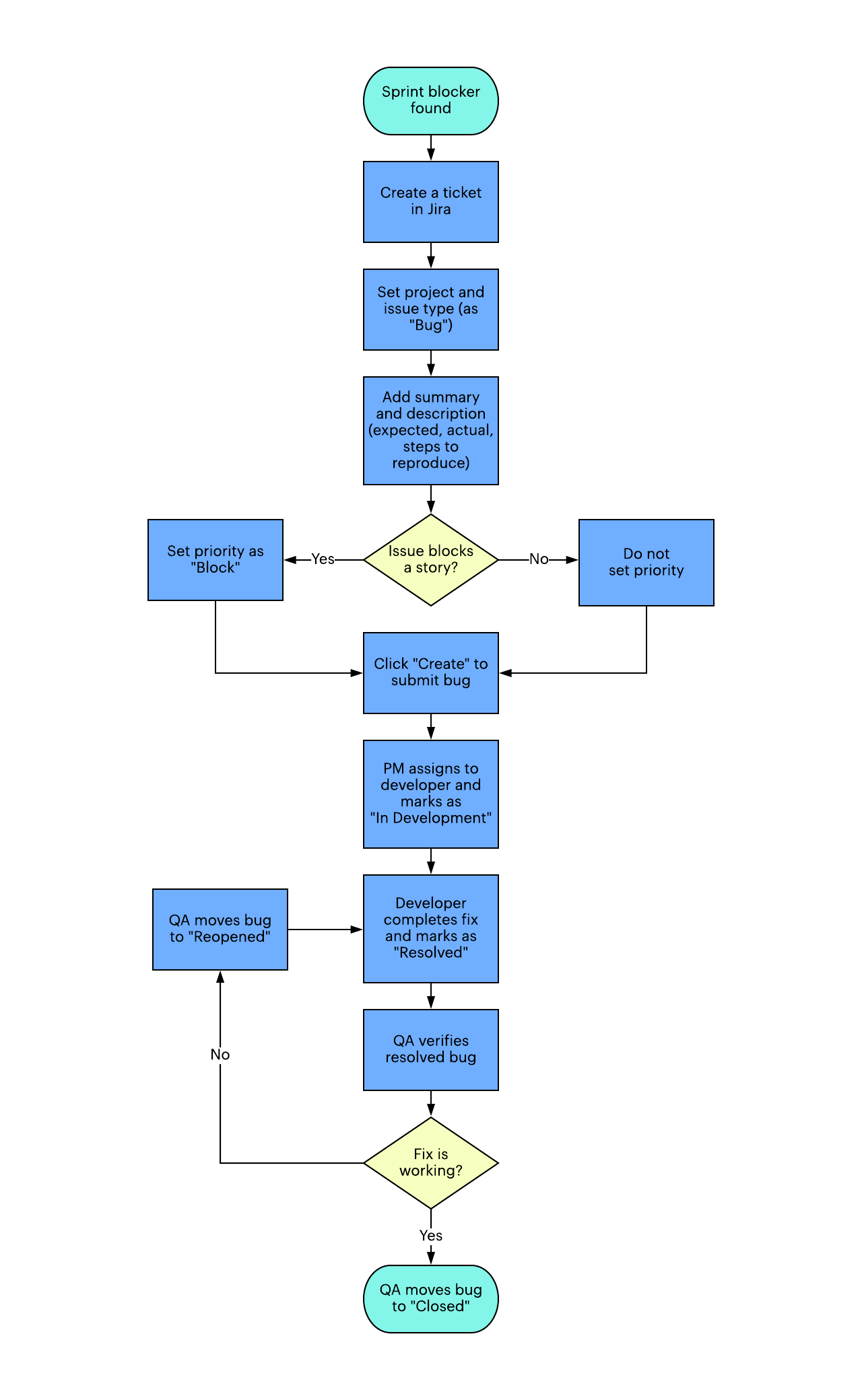
Fast and effective documentation provides the backup you need to push your projects through the Agile testing process. If you have a process for the QA team to log issues, you can visualize that process with a flowchart (like the example below) so everyone is on the same page as far as what to do when they discover bugs.