In a perfect world, machines would never break down, assembly lines would never stop, superior products without defects would be produced, product quotas would always be met, and products would be picked up and delivered on time.
But, unfortunately, it’s not a perfect world. Sometimes things happen that throw production off schedule.
This is where Total Productive Maintenance (TPM) comes in. TPM refers to the idea that operators are responsible for cleaning, maintaining, and improving their workstations to ensure safety and quality during production cycles. With TPM, the goal is to keep equipment working in optimal condition so that production processes move smoothly without breakdowns or delays.
What is TPM in Lean manufacturing?
Like many methodologies used around the world to improve workflow, increase production, increase quality, and decrease time to market, TPM was developed in Japan. It’s a natural extension of Lean manufacturing because TPM is also aimed at eliminating waste.
Total Productive Maintenance engages all employees in the effort to eliminate waste by improving the operation, reliability, and efficiency of equipment used to manufacture products. TPM shifts the responsibility of routine and preventative maintenance from members of the facilities or maintenance team to the operators who actually work with the equipment. This puts the people most familiar with the equipment in charge of making sure it runs at peak performance.
When implemented properly, TPM tries to achieve the following goals:
- No equipment failures
- No stops
- Faster and smoother production
- No defects
- Lower operating costs
- A safer working environment
It’s similar to performing routine maintenance on a car. Regularly changing the oil, checking the belts, changing the air filter, and rotating the tires is cheaper than paying full price to fix a neglected car.
The eight pillars of TPM and 5S foundation
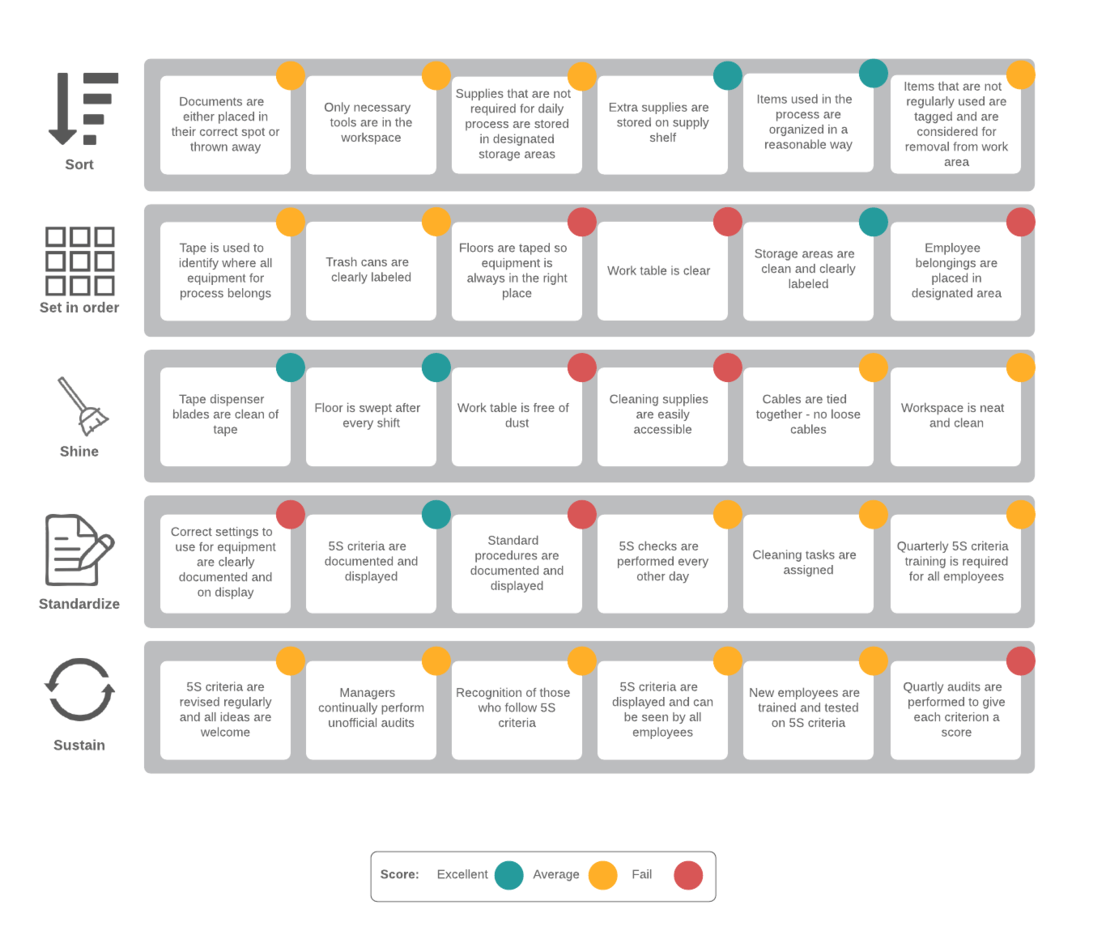
The TPM model is built on a 5S foundation—a set of five activities that are used to improve workplace organization, reduce waste, and increase operating efficiency. Each principle begins with the letter S.
On this 5S foundation, TPM erects eight pillars that encourage proactive and preventative measures that improve equipment performance and reliability.

5S methodology
In the early 1900s, Henry T. Ford introduced the principle of CANDO, an acronym that stands for Cleaning up, Arranging, Neatness, Discipline, and Ongoing improvement. About 50 years later, representatives from Toyota visited Ford to learn how to mass-produce automobiles.
The Toyota team was impressed by the CANDO principle and adapted it for their purposes as 5S: Seiri, Seiton, Seiso, Seiketsu, and Shitsuk. These have been loosely translated into English as Sort, Set in order, Shine, Standardize, and Sustain—the 5 Ss.
Sort
This activity involves removing the things that are not needed in the workspace. For example, it’s important to eliminate outdated materials or broken equipment that might otherwise get in your way. In addition, operators should sort equipment and materials by frequency of use.
Set in order
In this activity, operators put everything in its proper place. This makes it easy to find each item quickly and reduces time wasted.
Shine
Operators clean their workspace, equipment, and tools regularly to remove dust and dirt. Buildup of dust and dirt can cause deterioration and corrosion which can cause machines and other equipment to break down over time. Cleaning also promotes safety because it can help to prevent accidents.
Standardize
This activity involves setting standard procedures for performing the first three 5S activities. All employees need to be aware of the standards and should strictly adhere to them. Checklists and audits help to ensure that operators complete tasks as they have been documented in a standard operating procedures guide.
Sustain
When things are running smoothly, teams should still meet regularly to review and audit current operations and find where improvements can be made.