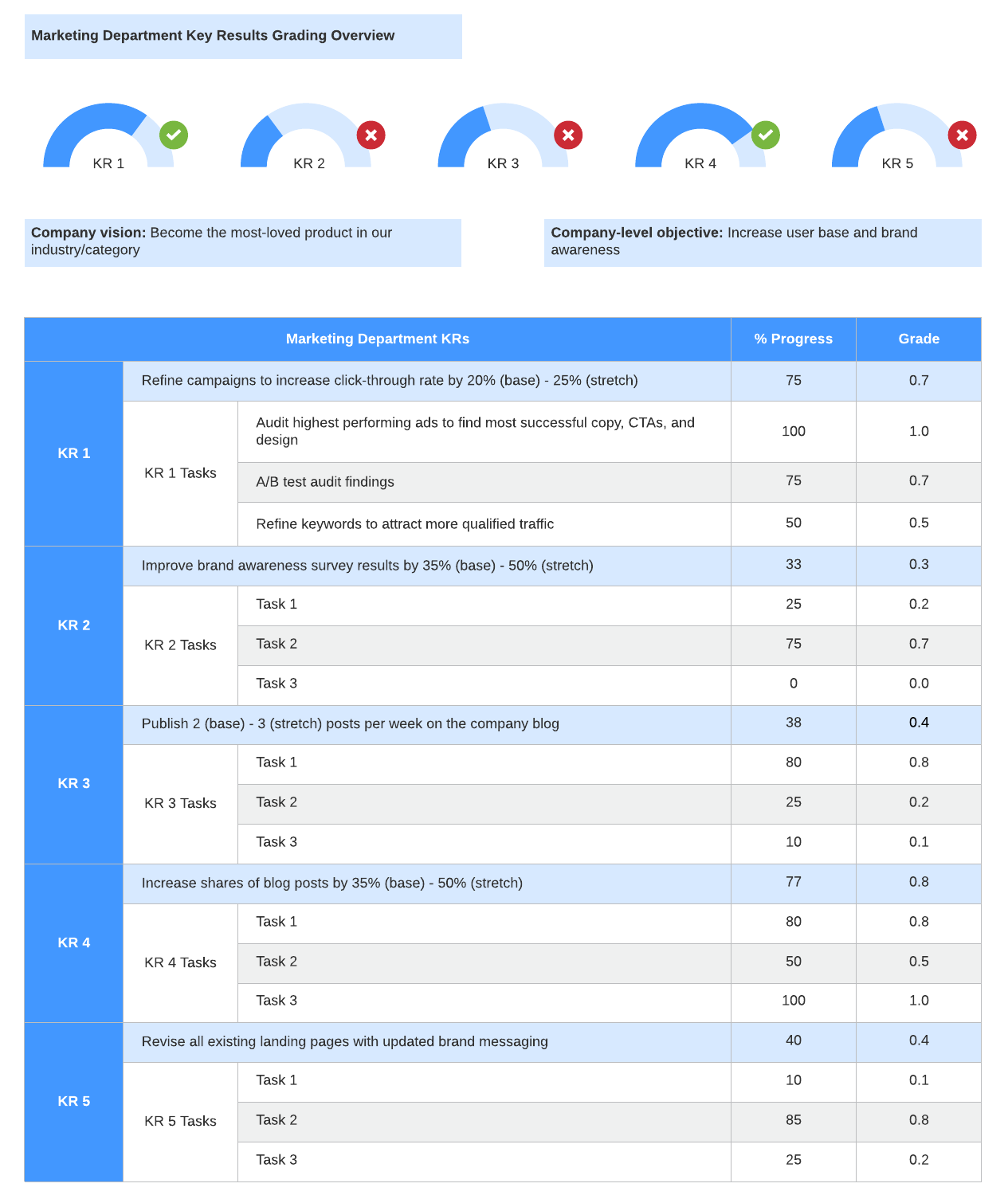
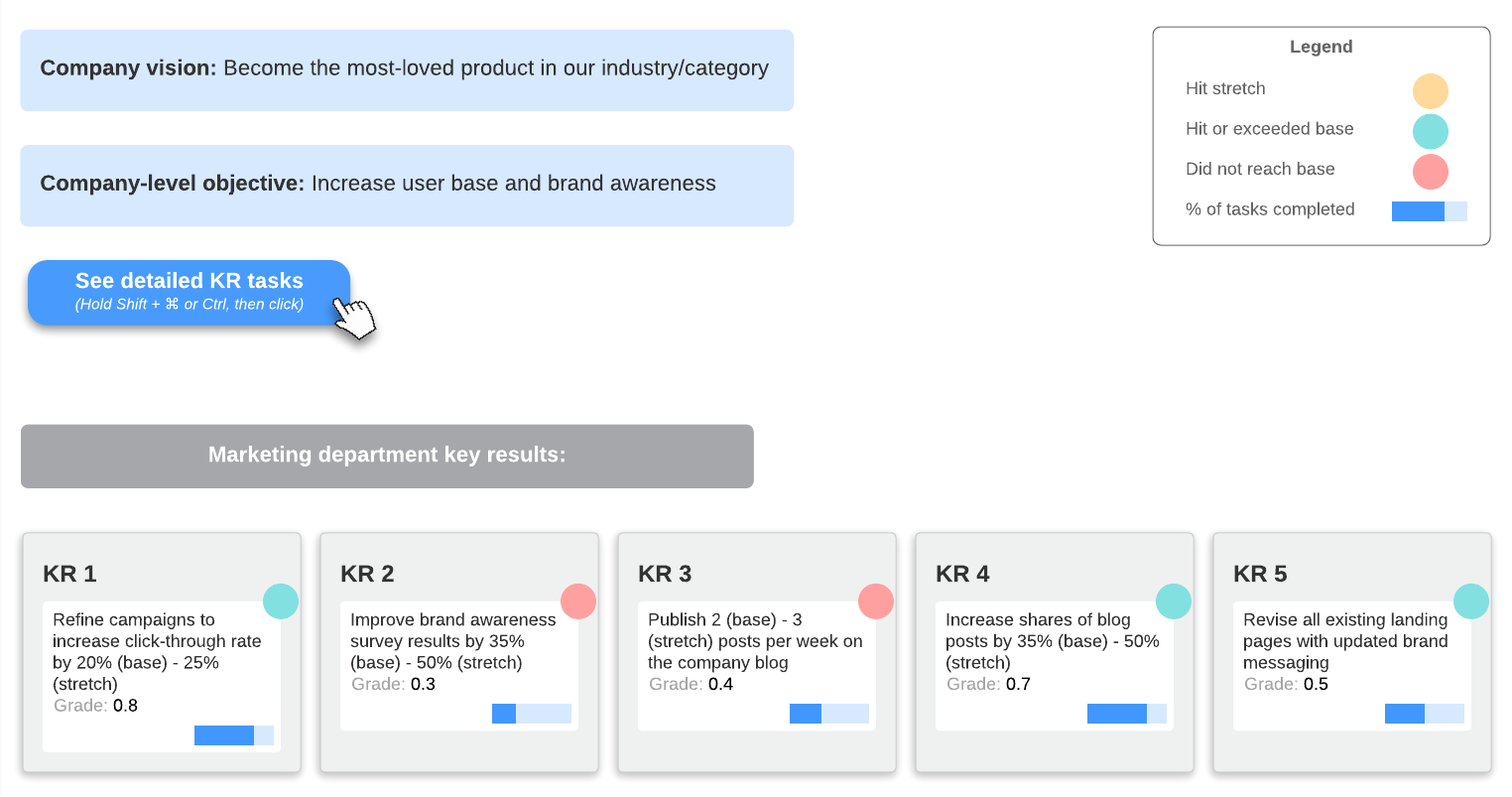
Goals are important. According to Bill Copeland, “The trouble with not having a goal is that you can spend your life running up and down the field and never score.” And regardless of how much you claim to love running, no one wants that.
Every company has its own method for preventing this perpetual field sprint. Here at Lucid, we use a system known as Objectives and Key Results (OKRs).
Our CEO, Karl Sun, personally witnessed the success of the OKR system while he was an employee at Google. So when he left Google to start Lucid, he brought OKRs along. Today, a new Lucidite’s first week isn’t complete without spending some quality time with Google Ventures partner Rick Klau learning about OKRs in his now infamous YouTube video.
What are OKRs?
The OKR system focuses on setting and communicating goals within an organization by connecting company, team, and personal objectives to measurable results. It pushes the company and its employees to stretch beyond their comfort zones while staying focused on a clearly defined and collective goal.
If you remember one thing from this article, we hope it’s the idea that OKRs are supposed to be stretch goals, not easy wins. OKRs are graded using a scale from 0 to 1—if you are consistently scoring a 1, you’re doing it wrong, whereas hitting between 0.6 and 0.7 means you are on the right track. Yes, it sounds bizarre to be writing goals that you know in advance likely won’t be met. But that’s the point. You know how it goes: reach for the moon and land among the stars.
How do OKRs work?
OKRs are established at three different levels that act like a funnel. First, set annual company OKRs that serve as your big umbrella ideas—these will likely evolve throughout the year. Then set company OKRs for each quarter that will get you to those annual goals—these shouldn’t change.
Moving down the funnel, each team writes quarterly OKRs together based on the company ones. Finally, every employee writes their personal OKRs based on both the company and team OKRs.
How do I write OKRs?
Whether you are an individual contributor or manage a team or department, follow these steps to get started with process of creating your own quarterly goals. We've even offered some templates to help you out.
1. Set an objective, or in other words, a general goal
It can be hard to narrow it down, but try to stick between 3-5 objectives per quarter so you have sufficient bandwidth for each. An objective should be broad, inspiring, indispensable, and timeboxed, and it should align with the company goals and corporate strategy. Don’t forget to write your objectives aggressively!
2. Write key results for every objective
Try to have a maximum of four for each. Key results demonstrate how you will accomplish the objective. They must be measurable, as these are your indicators of success.
3. Create a space to store OKRs
Identify a public space in which to store all company, team, and individual OKRs. Here at Lucid, we house our OKRs in Confluence.
4. Review your OKRs throughout the quarter
Hold 1:1s to go over personal OKRs and a company-wide meeting for company and team OKRs.
5. Grade your OKRs
At the beginning of each quarter, grade the previous quarter’s OKRs on the individual, company, and team levels using a scale from 0 to 1. Key results are graded individually, and an objective’s score is the average of its key results. Never use OKR scores for employee evaluation. Remember you should not consistently be scoring 1s!