Members of the FDD team
The FDD modeling team includes the following main roles:
- The project manager oversees the entire project.
- The chief architect is in charge of the overall design and modeling of the system. The chief architect works with other skilled developers in the planning phase of the development cycle.
- The development manager leads and mentors the development team and oversees the day-to-day programming activities.
- The chief programmer helps with analysis and design and may also be assigned to manage small development teams.
- The class owner is a member of the smaller development teams that are led by the chief programmer. Responsibilities include designing, coding, testing, and documenting features.
- The domain expert is a member of a team that understands the problem that the customer needs to be solved. The developers rely on the domain expert’s knowledge to ensure that they are working and delivering what is most important to the customer.
Why use feature-driven development?
You may want to consider using FDD methodology if your project grows too large and complex for smaller scrum teams to effectively handle the amount of work. This agile feature-driven methodology is well-suited for long-term projects that continually change and add features in regular, predictable iterations.
FDD is very scalable from small teams to large cross-functional teams because it is designed to always focus on what the customer needs and wants.
Advantages of feature-driven development
- Gives the team a very good understanding of the project’s scope and context.
- Requires fewer meetings. One of the frequent complaints about agile is that there are too many meetings. Scrum uses the daily meetings to communicate. FDD uses documentation to communicate.
- Uses a user-centric approach. With scrum, the product manager is usually considered the end user. With FDD, the client is the end user.
- Works well with large-scale, long-term, or ongoing projects. This methodology is very scalable and can grow as your company and the project grows. The five, well-defined steps make it easier for new team members or new hires to come up to speed on the project very quickly.
- Breaks feature sets into smaller chunks and regular iterative releases, which makes it easier to track and fix coding errors, reduces risk, and allows you to make a quick turnaround to meet your client’s needs.
Disadvantages of feature-driven development
- FDD is not ideal on smaller projects and does not work for projects where there is only one developer because it is hard for one or very few people to take on the various roles without help.
- Places a high dependency on a chief programmer who needs to be able to act as a coordinator, lead designer, and mentor to new team members.
- Provides no written documentation to the client, although there is a lot of documented communication among team members during the project development cycles. Therefore, the client is not able to get a proof for their own software.
- Emphasizes individual code ownership instead of a shared team ownership.
- May not work well with older systems because there is already a system in place and no overall model to define it. You may need to start over and work from the ground up.
5 steps in the FDD project life cycle
Now that you understand the benefits that feature-driven development can provide, let’s dive into the development process steps so you can start implementing them with your team.
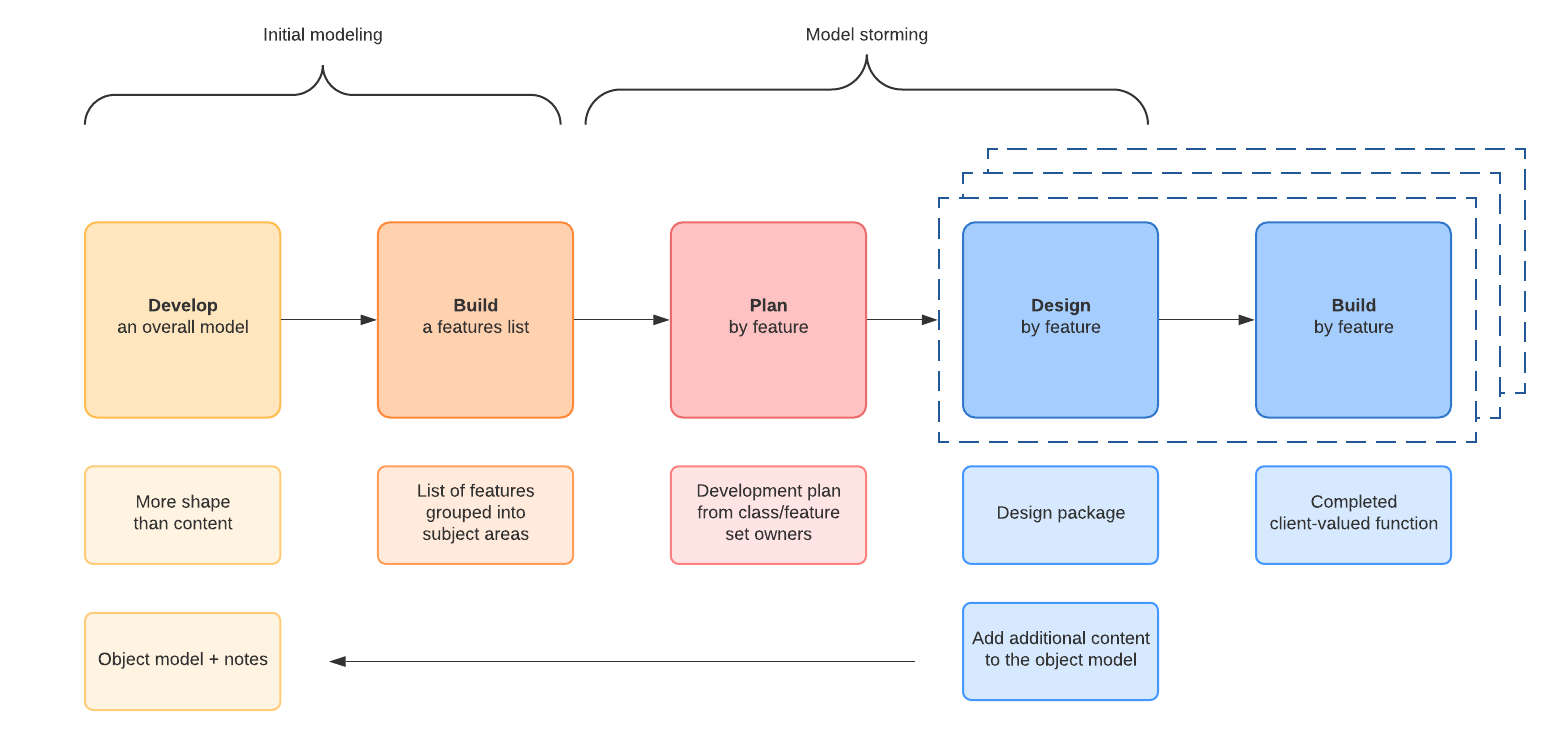
Step 1: Develop the overall model
This step is where you write your outline to define your domain model—the business problem you want your software development project to solve. The team works closely with the chief architect to define the scope and context of the system. Multiple domain models should be merged into one overall model as an outline for your system.
Step 2: Build a features list
The features list is similar to the scrum product backlog. Identify the features that are important to the client. Features are expressed as action, result, and object (for example, “validate the account number of the user”).
It should not take longer than two weeks to develop any given feature. If a feature will take longer than two weeks to build, it should be broken up into smaller features.
Step 3: Plan by feature
Determine the order in which the features from your features list will be developed and implemented. Consider potential risks, dependencies, team and individual workload, and any other obstacle that could hinder feature development.
Then assign feature sets to the programmers who are most capable and have the bandwidth to develop them within the specified timeframe.
Step 4: Design by feature
The chief programmer determines which features will be designed and built in a two-week iteration. This person also defines the feature priorities and determines who will be involved on the feature team. A design review needs to be completed by the whole team before moving forward.
Step 5: Build by feature
In this step, all of the items necessary to support the feature design are implemented. The user interface is designed, and a feature prototype is built and tested. If the feature passes the test and is approved, the completed version can be added to the main build and made available to customers.