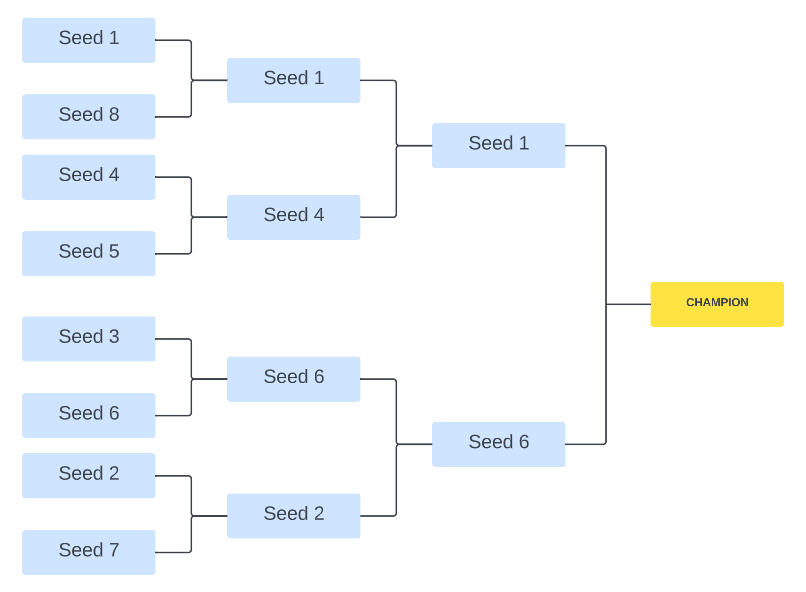
Matchups for a single-elimination tournament can be determined randomly, or based on a seeding system. Seeds numbers could be assigned to teams based on their overall record. In an eight team bracket, the team with the best record is the number one seed. The team with the worst record is the eighth seed. Seed 1 plays seed 8, seed 2 plays seed 7, etc. The idea is to ultimately end up with seed 1 competing against seed 2 to determine the winner. But there could be upsets along the way, with a lower seed beating a higher seed. Your bracket might look something like this:
Double-elimination bracket
In this type of competition, participants need to lose twice before they are eliminated. The bracket consists of two brackets: a winners (W) bracket and a losers (L) bracket. This means there are two brackets to track to determine the eventual winner of the final round. It works like this:
- All teams start out in the W bracket for the first round.
- The losers of the first round move to the L bracket.
- The losers of the matchups in the L bracket are eliminated.
- The winners in the L bracket play the losers of subsequent rounds from the W bracket.
- The winners in the L bracket move on for the chance to play in the championship round against the winner of the W bracket.
- If the winner of the L bracket beats the winner of the W bracket, they meet in a second game because the team from the W bracket needs to lose twice to be eliminated.
- If the winner of the W bracket beats the winner of the L bracket in the first game of the final round, the tournament is over because the team from the L bracket will have lost twice.
Round Robin bracket
Round Robin tournaments are set up to ensure that every team or individual in the competition has the opportunity to play each other once. In this type of tournament, participants are not eliminated, even if they lose more than one or two games. Instead, they each get a chance to play against each other. The player with the best record after all the matches have been played is declared the winner.
Consolation bracket
A consolation tournament is sometimes used to determine which team or participant will finish in third or fourth place. It’s kind of like a double-elimination bracket except that the participants in the consolation bracket have no chance of winning the championship.
When the teams in the main bracket lose, they are moved to the consolation bracket. Losers are eliminated and the winners move on until a third and maybe fourth place competitor is determined.
You might want to use a consolation bracket when there are different prize levels. For example, fourth place gets $100, third place gets $150, second place gets $200, and first place gets $300.
Other uses
Most people think of brackets in association with sports or games like chess or poker. But you can use them for other things like deciding your favorite movies, songs, restaurants, and so on. This is subjective, but can still be fun for a group activity or team icebreaker.
However you decide to fill out your bracket, the concept is the same. You will have a number of individual items going head-to-head in the first round. Participants can vote for their favorite in each matchup. The items with the most votes move to the next round (single-elimination) until a favorite is chosen.
Use Lucidchart to set up a bracket
Lucidchart is a web-based diagramming application that you can use to create a bracket for any event. The free template library includes tournament bracket templates that you can customize to your use case. Or, you can use the following tools and features to set up any type of bracket you want:
- Shape Library: Lucidchart includes a variety of libraries that contain easy-to-use shapes and lines suitable for any type of diagram you want to draw. Simply drag and drop shapes and lines onto the digital canvas. Then move them, resize them, and add text and color to design your bracket exactly how you’d like.
- Data Linking: This lets you link shapes on the canvas to applications like Google Sheets and Microsoft Excel, or to a comma-separated value (CSV) file. As you update the linked data to reflect the results of each matchup in each round, your bracket diagram is updated automatically.
- Share documents: Diagrams can be easily shared with anyone you’d like to gain access. If you are working as a team on a single bracket, you can share your version of the bracket with them. Together you can collaborate and make predictions for each round of the event, while you manage the permissions for each member of your team. For example, you may want to fill out the entire bracket and only give team members permission to make comments. This way, you can get input from others and come to a consensus for filling out the bracket with your predictions.
Easy editing: With Lucidchart’s easy-to-use intuitive tools, you can group together multiple shapes to simultaneously adjust the scale or rearrange the layout. With a few simple click and drag motions, you can create a bracket that looks exactly how you want.