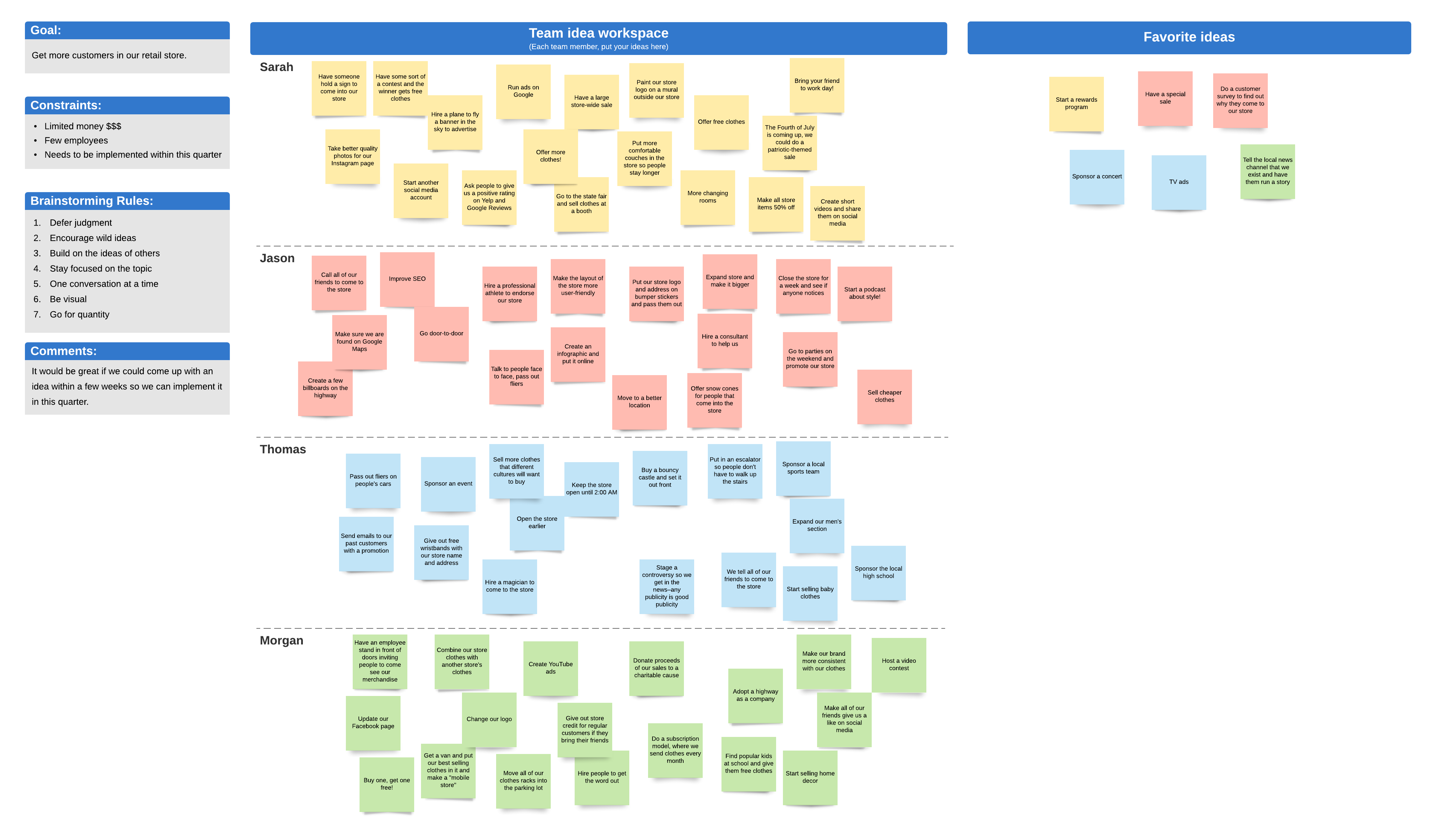
Round robin brainstorming
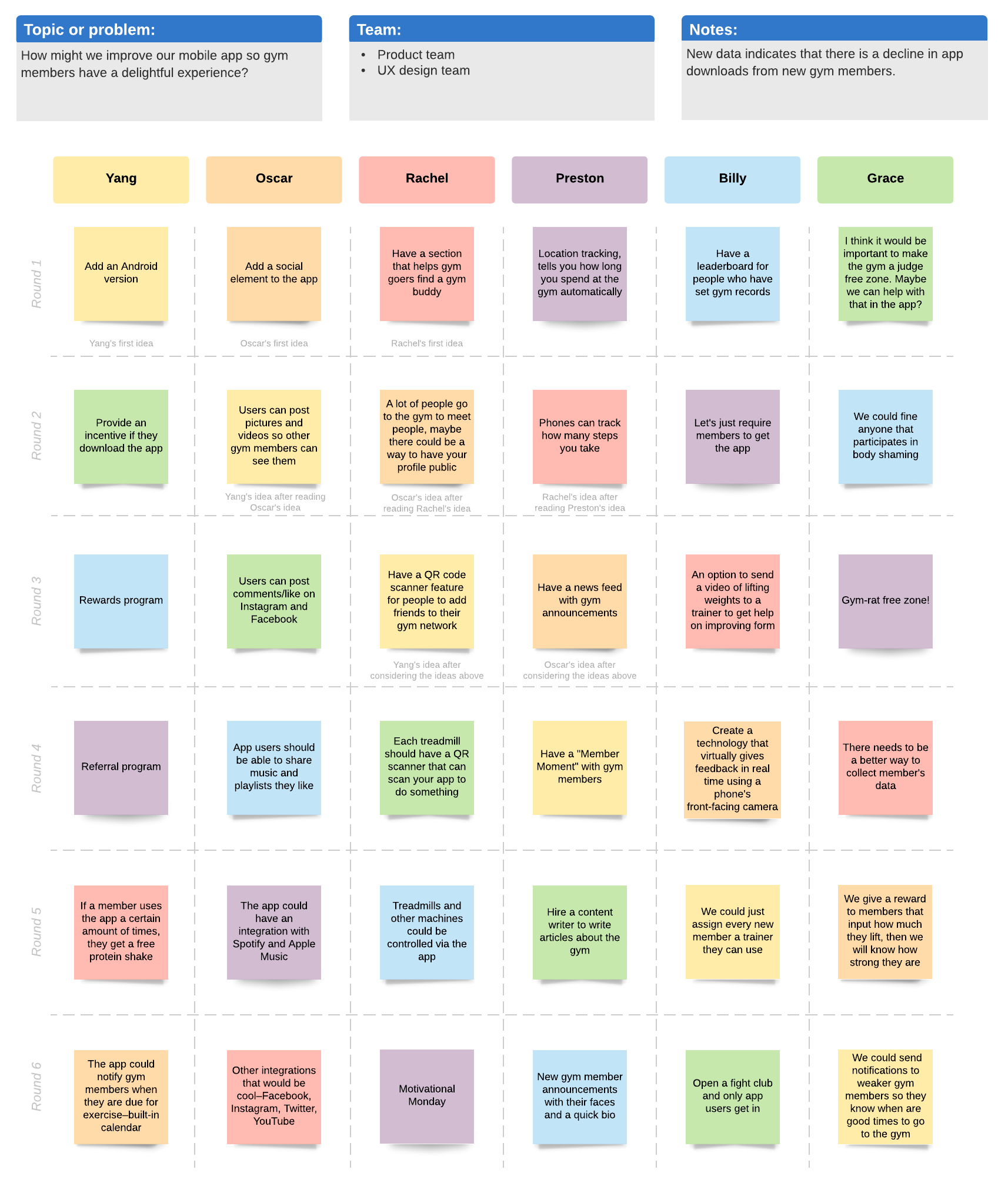
To engage in this brainstorming technique, begin with having everyone sit in a circle. A team leader or facilitator will then pose a question or offer a request for ideas and have everyone in the circle contribute one by one.
This strategy is great for middle- to large-sized teams who may have quieter team members or for any team with noticeable imbalance in creative contribution. The most important rule for this technique is to treat all ideas with equal weight—give each teammate the same time and attention as they share, and avoid developing any ideas until everyone has had a chance to contribute. If and when a team member says that “Person X already said my idea,” offer them time to come up with a new idea while completing the round robin.
Rapid ideation
Operating within a time limitation can often produce higher quality work. Indeed, Parkinson’s Law teaches us that “work expands so as to fill the time available for its completion.” Rapid ideation uses this phenomenon to its advantage: By setting a time limit on team members to contribute as many ideas or solutions as possible, team managers can maximize productivity and results.
Rapid ideation works well for a few different types of workers—for teams who dislike meetings, or who tend to get sidetracked, rapid ideation is a great way to approach the brainstorming stage of project execution.
A helpful tip to remember: Get silly! Research shows that teams who share funny or embarrassing stories about themselves reported 26% more ideas shared across 15% more categories over teams who kept meetings more formal. Having the space to let down certain social barriers reduces overthinking and produces a greater flow of ideas.
Reverse brainstorming
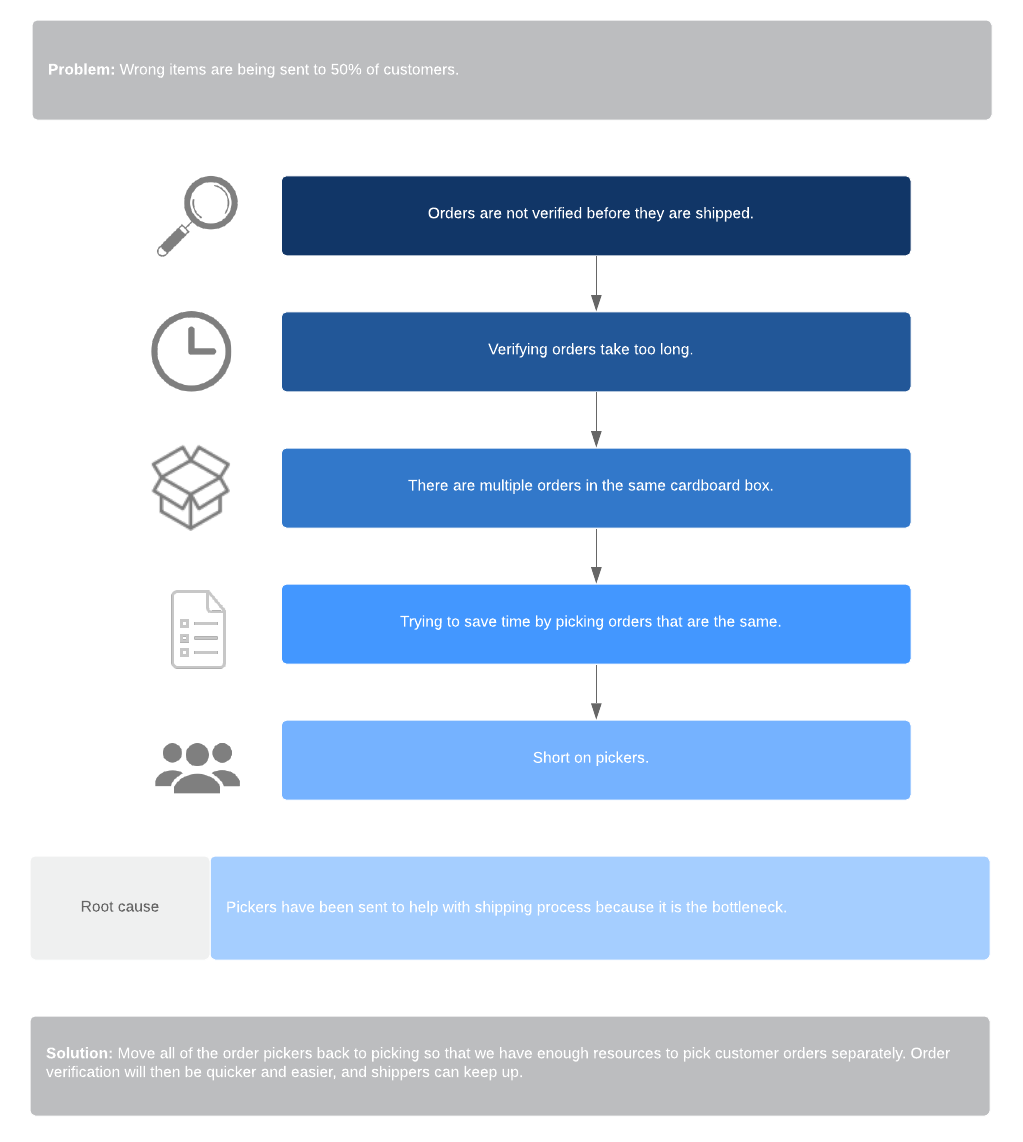
Most brainstorming techniques ask participants to solve a problem. Reverse brainstorming has participants cause a problem. Rather than forming solutions to a problem, reverse brainstorming has a facilitator ask a question like “How can we cause this problem?” Responses are then recorded and used as springboards to ideate a solution by working through the responses backwards.
Reverse brainstorming is a powerful way to open up new solutions to recurring problems: By challenging participants to work backwards, certain insights that may have been hard to imagine normally become crystal clear from a new perspective.
Stepladder brainstorming
This interesting style of brainstorming was developed in 1992 and involves teammates sharing their ideas individually before being influenced by the group.
The process starts with a facilitator posing a question or problem to the entire group and then having almost every group member exit the room, leaving two members present. These remaining two members share their ideas together while the rest of the team waits outside, until the facilitator directs an outside teammate to join the two inside.
The third and new teammate then shares their idea first, followed by the other two teammates. A fourth group member then enters the room and shares his or her idea first, followed by the other teammates present. The process continues this way until all group members have joined the room and shared their ideas.
Stepladder brainstorming is noted for solving the problem of groupthink by having participants share ideas individually and without influence from the group. It also allows the more shy group members to contribute without being intimidated by a room full of people.
SWOT analysis
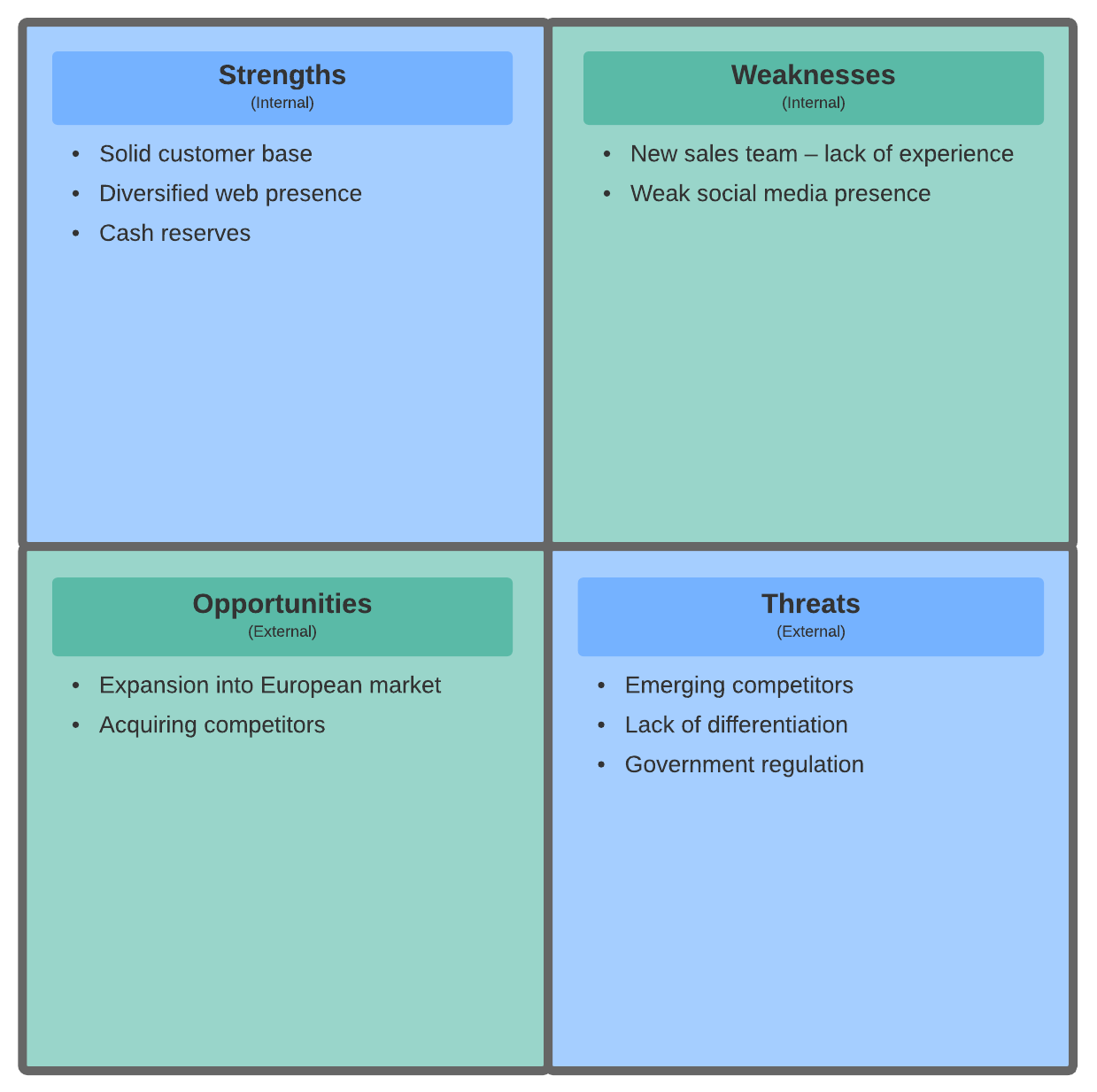
SWOT analysis isn't exclusively a brainstorming technique: It's a strategic planning exercise that you can use to evaluate a product, project, person, or business. However, it may be valuable to focus your brainstorm with this mindset. SWOT stands for:
- Strengths: How does the product, project, or business dominate and stand out from its competitors?
- Weaknesses: What are the flaws that can hurt or put the product, project, or business in jeopardy?
- Opportunities: What opportunities could the business capitalize on?
- Threats: What are the possible downfalls lurking for the product, project, or business?
Spend some time in each category and add your teammates' thoughts onto a SWOT matrix.