Key elements of the Business Model Canvas
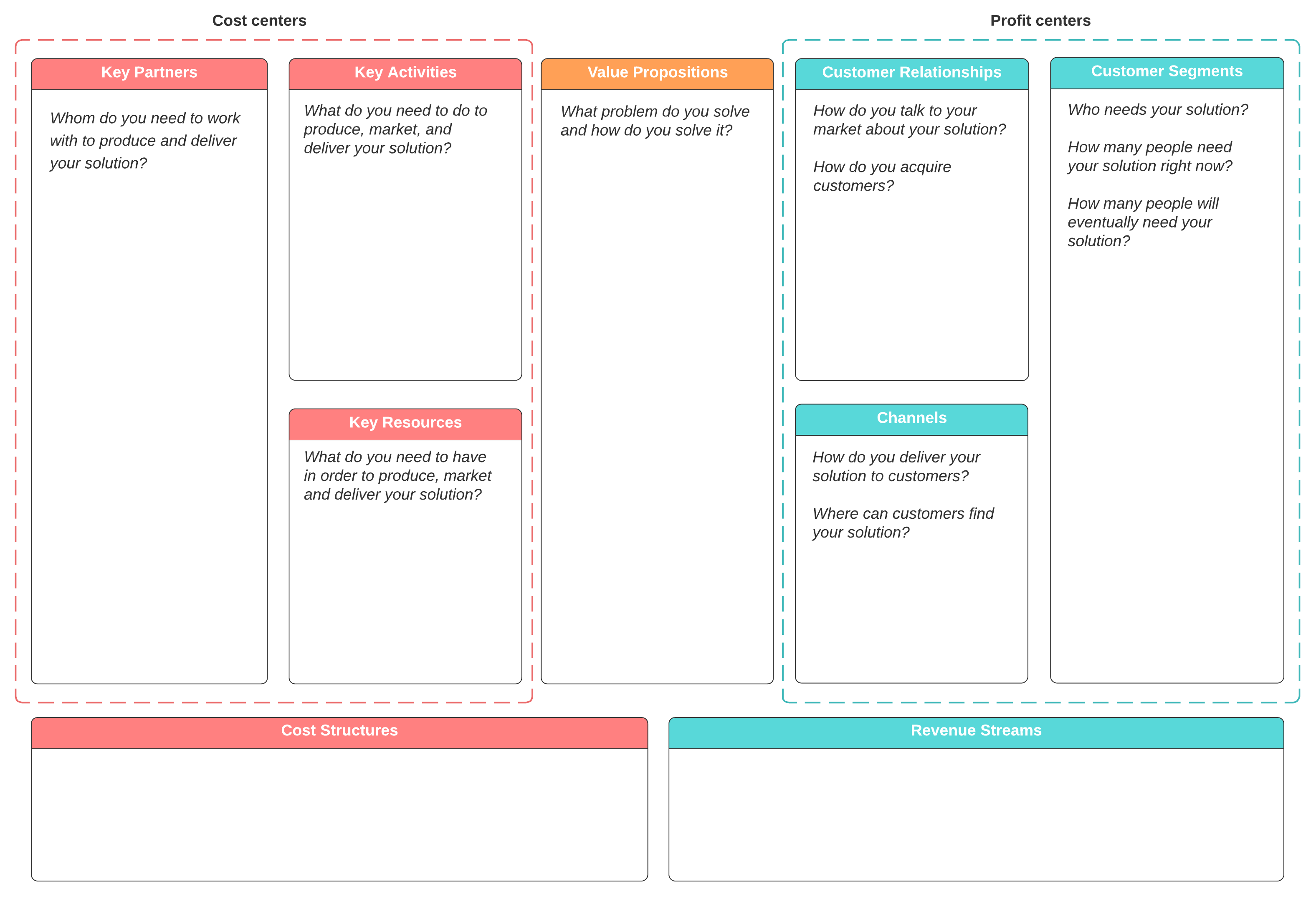
The Business Model Canvas consists of nine areas of strategic planning. If you’re starting a new business from scratch, don’t worry too much about the details––just get your vision down so you can get moving. Include the following elements of the Business Model Canvas:
Value proposition
Your value proposition should be easily communicated in a single sentence, and it should inform everything you do. What’s your mission? What problem are you going to solve, and how are you going to solve it? What products and services will you offer to meet customers’ needs (these may vary by customer)?
Most importantly, you want to define how your brand will be different from what’s already out there.
Customer relationships
Think about the kinds of relationships you want to establish with your customer segments. How will you communicate and build rapport with your customers throughout their journey? Will you offer personal assistance, create a community environment, or present a self-serve model?
Consider how and where your customers like to communicate. Every communication should drive home the problem you solve and why your solution is the best (or, better yet, only) one around.
Customer and market segments
These are the people and organizations for whom you create value. Who could really use the solution you’re offering? If there are multiple groups, list them all out.
You may need to investigate potential buyer personas, find niche markets that fit your offerings, or come up with a multi-sided market strategy that brings together different groups of customers.
Channels
Channels are the points at which you interact with customers to deliver value. How are the people who need your solution going to buy it? Take a look at your customer segments. Where do they spend money right now? Try to make it as easy as possible for a customer to say “yes” to buying your solution.
Key partners
You’ll probably rely on other people––suppliers, distributors, etc.––to create and deliver value to your customers. What individuals or entities outside of your business will you need to work with in order to produce, market, and deliver your solution? What key activities or resources can someone else take care of so that your business can focus on your value proposition?
Key activities
If an activity isn’t directly tied to delivering on your value proposition, then it isn’t key, and you probably shouldn’t be doing it. So what do you absolutely have to do in order to produce, market, and deliver your value proposition?
Key resources
If the resource isn’t necessary to deliver on your value proposition, ask yourself if you really need it. What do you absolutely need to have in order to produce, market, and deliver your solution? These could be human, financial, physical, or intellectual resources.
Cost structure
This should be a description of the costs of operating your business. How much will your key activities, resources, and partners cost you? At this point, it may be a good idea to take a second (and a third) look at each of these categories and cut out everything that isn’t absolutely essential to delivering on your value proposition.
Pay attention as well to any fixed costs you’ll have to incur, variable costs you’ll need to keep an eye on, and changes in costs as you scale.
Revenue streams and pricing model
Decide what customers will pay for and how they will pay you. How much do you need to charge? Keep in mind that you need to make enough to cover your costs and have something left over to grow your business and reward you for your efforts.
Additionally, will your solution be subscription-based? Will you offer individual purchases? Choose a pricing model that will fit best with your customer base and your cost structure.
How to use a Business Model Canvas
The main goal of using the Business Model Canvas is to validate your business model. By laying out all the components, you can find simple, small-scale ways to test each aspect of your business model in a cycle of improvement.
1. Fill out the canvas
Filling out the canvas is quick and painless, and it should give you a lot of clarity. Try to finish it in just 30 minutes. Start with the value proposition and then proceed in the order outlined above, moving from the theoretical to the more concrete aspects of your strategy.
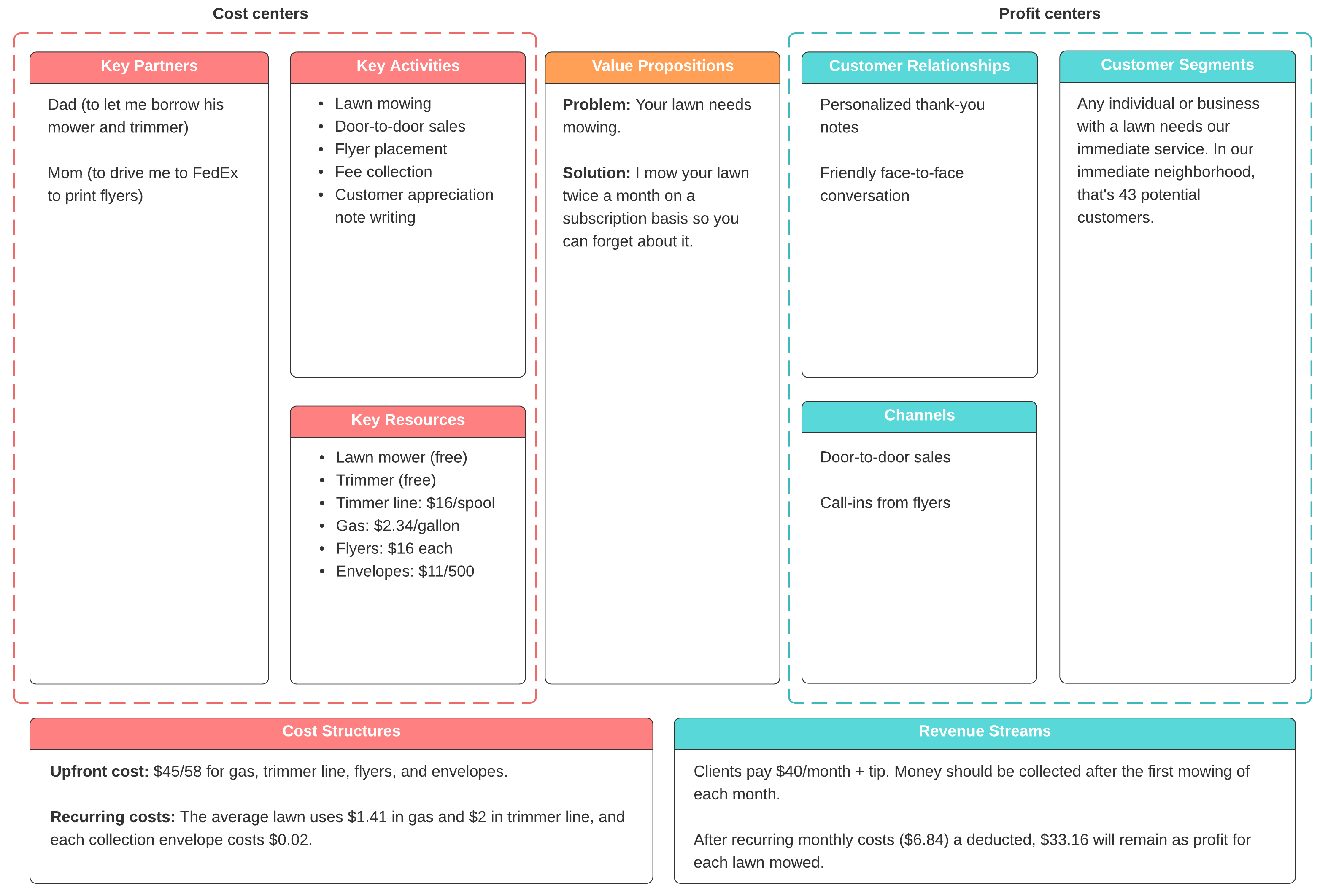
To demonstrate what a filled-out canvas might look like, imagine that a seventh-grader named Timmy wants to start a neighborhood lawn mowing business over the summer. His Business Model Canvas might look something like this: