QCI model
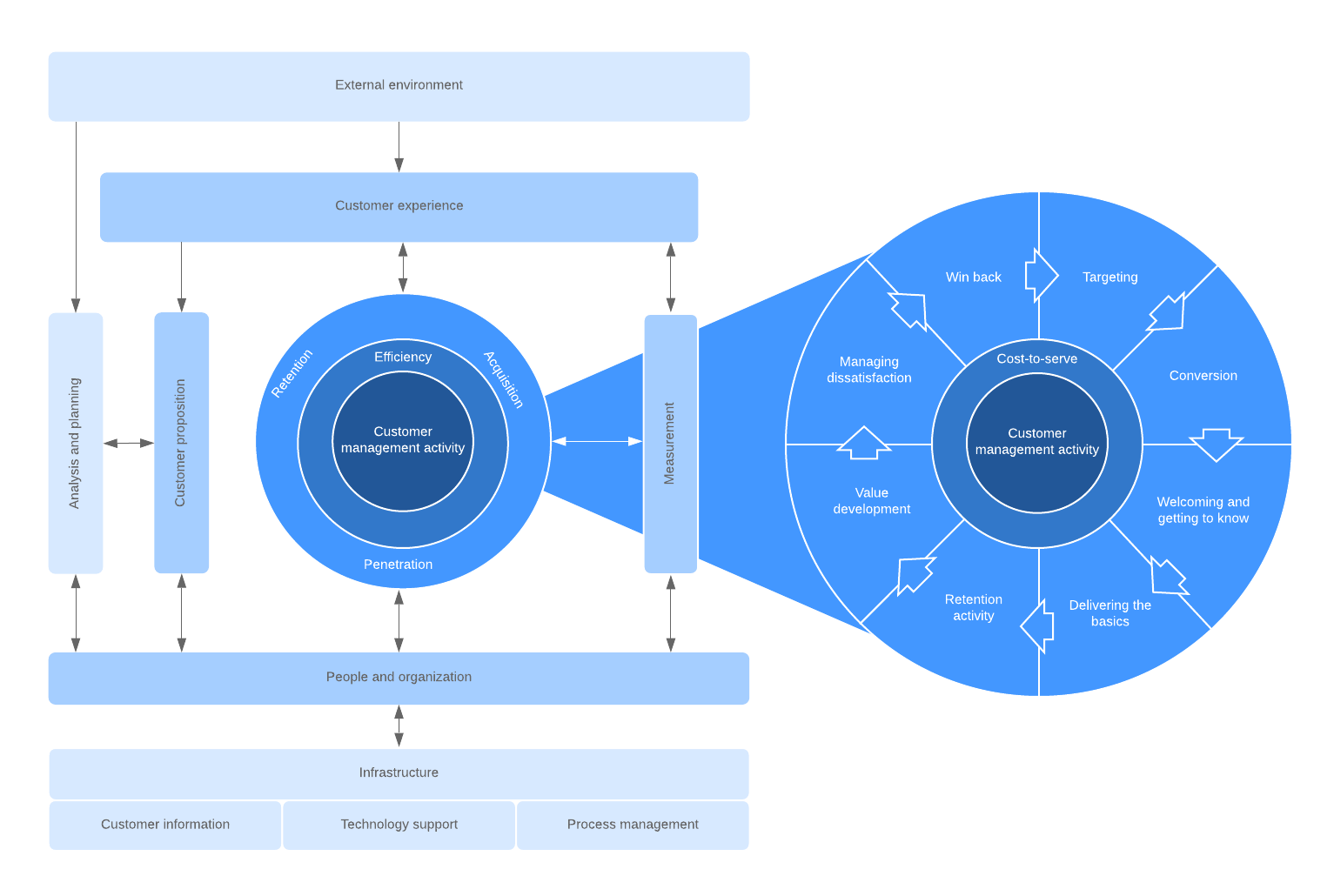
Described as a customer management model rather than a customer relationship model, the Quality Competitive Index model focuses on three main activities: acquisition, retention, and penetration.
The QCI model starts with the customer’s external environment at the top—their pain points, business goals, and other factors will affect whether they are ready to buy or interact with your sales team, which in turn impacts the customer experience. The customer experience then affects customer proposition (what you offer the customer) and customer management activities. As you can see from the magnified version of the inner circle, many activities are involved to acquire and retain customers.
The QCI model also considers the people and technology involved with keeping this whole system going. Although QCI has replaced the word “relationship” in fraCRM, this framework of CRM still starts and ends with people.
Payne’s Five Process model
The Five Process CRM model was developed by Adrian Payne and Pennie Frow. This model of CRM emphasizes a cross-functional approach for effective CRM processes.
There are two main components to the model: cross-functional CRM processes and key elements of CRM implementation.
Payne’s model outlines five processes:
- Strategy development
- Value creation
- Multichannel integration
- Information management
- Performance assessment
There are four key elements necessary for a successful CRM implementation:
- CRM readiness
- CRM change management
- CRM project management
- Employee management
When implementing a CRM strategy, companies should conduct a CRM readiness assessment to determine how prepared they are to implement a new CRM process.
Additionally, because CRM involves a fundamental cultural and operational shift, companies should invest in CRM change management and project management as the new strategies are introduced and the complexities of the CRM initiatives grow.
Finally, employee buy-in is crucial for successful CRM. Make sure your employees understand the strategies and processes and engage with the new customer-centric culture.
Without these underlying conditions and elements, the CRM processes cannot succeed.
CRM value chain
A value chain is a high-level model developed by Michael Porter that identifies the processes a business uses to develop an end product or service for the customer. The goal of the value chain model is to identify and prioritize the most valuable activities to the company and improve processes to gain a competitive advantage.
The CRM value chain model applies this principle to customer relationships. This CRM model observes all the stages and activities required to build a relationship with a customer.
These activities are divided into two stages: primary and support.
Primary stage
The primary stage of CRM value chain has five main processes that enable the strategy.
-
Customer portfolio analysis: Similar to the IDIC model, the first step of the value chain model is to analyze your customers to identify your SSCs (a.k.a. the customers who create the most value for the company). This analysis stage helps companies understand their customers so they can better address their needs and expectations and develop strategies to maximize their lifetime value.
-
Customer intimacy: The next step is to engage with the customer and build on the original database of information. At each touchpoint, companies should be collecting data on the interaction in order to better understand and serve their customer. The better you know your customer (and adjust your service accordingly), the more likely you are to retain their business over the long term.
-
Network development: A business’s network includes all people and entities involved in the value chain, including partners, suppliers, customer service, investors, etc. The goal is to use your customer data to inform the processes at each level of your network so that the entire system works together to optimize your customer’s experience.
-
Value proposition development: Armed with your customer information and interaction data, you can create value for your target customers. The idea is to shift the focus from the product to your service and to reduce process costs to create more value for the customer.
-
Relationship management: The last stage of the value chain model is to manage your customer lifecycle. This process involves evaluating your business processes and organizational structure to manage acquisition, retention, and customer development.
Support stage
There are five supporting conditions necessary in order to effectively implement the strategic processes of the primary stage:
- Leadership and culture
- Procurement processes
- HR management processes
- IT/data management processes
- Organization design
Creating and developing these underlying conditions will support a successful CRM value chain implementation.
Using Lucidchart to model your CRM strategy
Building a loyal customer base is key to growing a sustainable business. In fact, just a 5% increase in customer retention can result in 25% higher profits. But CRM is a big undertaking. Keeping track of all your processes and data can be overwhelming. Luckily, Lucidchart can help.
Lucidchart is a cloud-based diagramming solution that makes it easy to create streamlined flowcharts and diagrams.
Use Lucidchart to visualize your CRM model, document your processes, and even map out your sales org design. Lucidchart also integrates with Salesforce so you can import your schema directly into your document to visualize your data—complete with the official Salesforce shape library—and make connections more easily.