As a business matures, what it needs to deliver a competitive product or service will grow and evolve. From personnel to workflow management to capital investment to emerging technologies and beyond, successful and sustainable businesses must adapt as their industry changes and the needs of their customers change.
The companies that fare best through these changes are the ones who forecast their industry’s evolution and make thorough plans accordingly. Planning for these changes can be a challenge—but with the right data, research, and most importantly, a clear roadmap, a company can not only survive downturns but thrive through them.
Perhaps the area of business that you'll need to update and project most accurately is how you'll use and apply available technologies. By improving work processes, delivering more accurate and useful data, and generally improving capability, technological advancement may be the best way to improve your business.
This article will focus on technology roadmaps—what they are and how they may be useful in planning a sustainable future for your business or organization.
What is a technology roadmap?
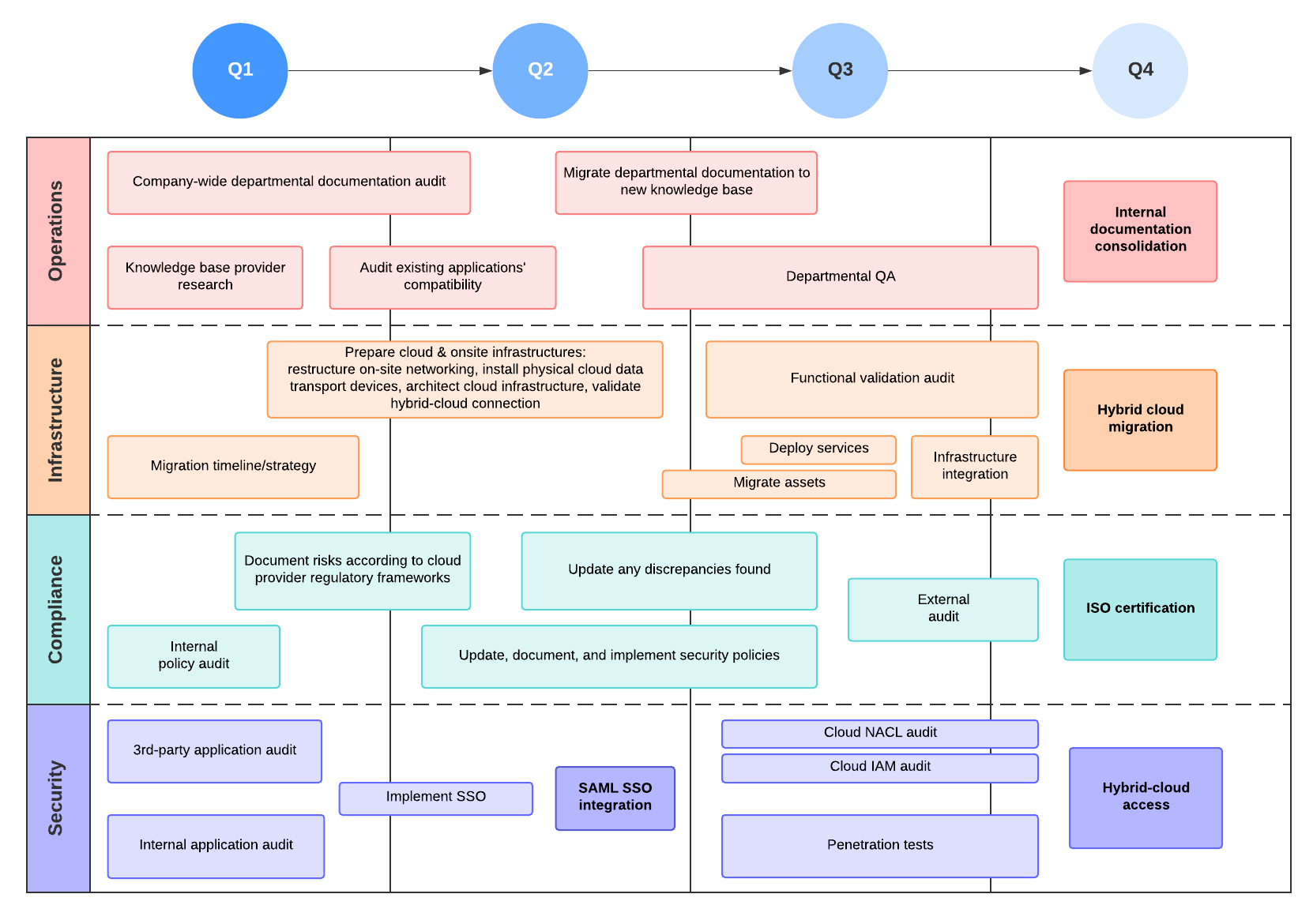
A technology roadmap is a display, document, or diagram that illustrates the technology adoption plan at a given organization. Technology roadmaps help business leaders plan and strategize when and why they will onboard certain technologies while avoiding expensive mistakes. Roadmaps can also plan for technologies becoming obsolete.
An effective technology roadmap should also outline a strategy to reach short- and long-term digital transformation goals, if applicable.
There are two main categories of technology roadmaps: tech roadmaps that generally show which technologies to use and stop using, and a subtype focusing on IT systems. Let’s go over both.
Technology roadmap
A technology roadmap illustrates the technology presently available and emphasizes scheduled improvements. A technology roadmap should also consider which technologies will become obsolete or are scheduled for end of life. For example, a technology roadmap will show when the previous system will sunset and when the new one will be implemented.
As organizations lay out their strategy and implementation to help execute on their vision, a technology roadmap will help them determine which technologies to invest in and how to implement them. Technology roadmaps should enable technological infrastructure improvements to meet both long-term and short-term targets of the business or organization in mind.
IT systems roadmap
An IT systems roadmap is a diagram or model designed to set the parameters that enable key functioning across the business or organization. An effective IT roadmap will lay out current IT capabilities, projected IT needs, and any improvements you plan in order to make to execute against your business strategy.
Generally, IT roadmaps communicate plans about the major systems that keep your business running. These systems include customer relationship management systems (CRM), enterprise resource planning systems (ERP), data analytics systems, identity management systems, cybersecurity systems, and more.
Why do you need a technology roadmap?
A technology roadmap's overall purpose is to align your target stakeholders, like IT, software engineering, operations executives, and even sales teams, by creating a course of action to onboard new technology solutions or to maintain existing ones.
This method helps teams visualize, prepare for, and execute the desired outcomes for the organization. Creating a thorough technology roadmap gives you the ability to:
- Have a clear picture of your company’s IT infrastructure abilities and how they align with business outcomes.
- Address any current IT issues.
- Cut costs by removing any unnecessary technologies and applications.
- Increase productivity by implementing technology that serves your immediate needs.
- Improve IT and cybersecurity.
- Avoid or mitigate against system failures by learning any weaknesses in your IT infrastructure.
- Resolve any conflicts around business priorities.
- Prepare for digital transformation.